The holy grail of every particle physics experiment is the discovery of a new particle. Finding a new constituent of matter may earn you eternal glory within the history of physics. Unfortunately, since the last missing piece of the Standard Model, the Higgs boson, was discovered in 2012, and with still no clue about the nature of dark matter and dark energy, there is not much hope to stumble upon a new fundamental building block of matter any time soon.
Luckily, this is not true for composite particles, especially the strange world of quark matter still yields some potential for new discoveries. The latest of such was the observation of a new tetraquark by the LHCb experiment. But what the hell is a quark anyway and why is it named after a German dairy product?
The Proton Is Not Just a Dot
Up until the 1950s, it was believed that subatomic particles such as the neutron and proton are elementary, point-like particles with no inner structure. In the following decade, the progress made by accelerator experiments led to the discovery of an entire zoo of new particles. This sudden “particle explosion” irritated physicists who believed in the beauty of simplicity. Wolfgang Pauli exclaimed that had he foreseen this, he would have become a botanist instead. US physicist Willis Lamb suggested that the discovery of a new particle now ought to be punished with $10,000 fine instead of a Nobel Prize.
In 1964, Murray Gell-Mann and George Zweig independently came up with a model proposing that these new particles are not elementary but instead composed of a combination of new fundamental particles called quarks. The name was coined by Gell-Mann who pronounced it “kwork” and later adopted the spelling from the following cryptic line in James Joyce’s book Finnegans Wake.
Three quarks for Muster Mark!
Sure he has not got much of a bark
And sure any he has it’s all beside the mark.
While Gell-Mann interpreted the line as a call for drinks (“Three quarts for Mister…”) it is unclear what James Joyce really meant. Some think it represents the cry of a seagull while others attribute it to the German word for a kind of cottage cheese.
Definitive proof for the existence of quarks came in 1968 when experiments at the Stanford Linear Accelerator Center showed that the proton is not a point-like particle but instead contains some inner structure. Still, people only recognized later that what they observed were in fact quarks.
A Quark Comes Rarely Alone
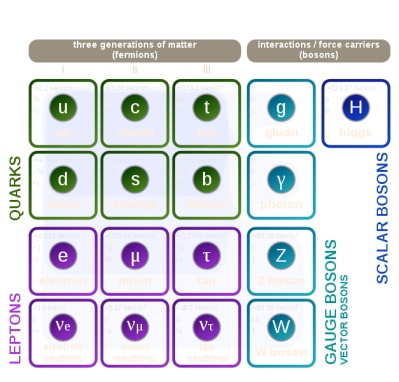
There are six different kinds of quarks (up, down, top, bottom, strange, charm) that have different masses and charges. For every quark there is also an antiparticle with the same mass but opposite charge. The proton, for example, consists of two up quarks (u) with charge +2/3 and one down quark (d) with charge -1/3, while a neutron consists of two down quarks and one up quark.
Like the electric force that acts on charged particles, each quark contains a color charge blue, green, or red, which makes it susceptible to the strong force. In nature, one can only observe color-neutral particles that consist either of three quarks with different colors (called baryons), or a quark-antiquark pair (called mesons).
The fact that one cannot produce isolated quarks is known as confinement. It can be understood as a peculiarity of the strong force that behaves similar to a rubber band. When trying to separate two quarks it becomes more and more difficult with increasing distance so that at some point it is energetically more favorable to create another quark-antiquark pair.
Tetraquarks and Pentaquarks
Credit: LHCb collaboration
Baryons and mesons are not the only possibilities to combine quarks in a color-neutral way. A tetraquark is also viable, being a combination of four quarks qqqq, where q and q respectively refer to a quark and antiquark. A pentaquark qqqqq may even exist.
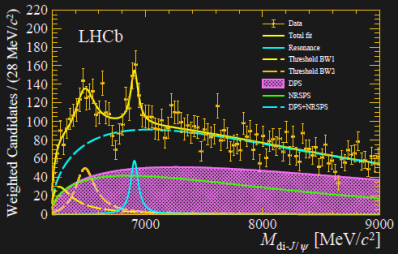
To search for penta- and tetraquarks one smashes together electrons or protons in an accelerator and analyses the particles produced in the collisions. Since such exotic particles have extremely short lifetimes, they cannot be directly observed in a detector. Instead one plots the number of recorded events vs. the so-called invariant mass, calculated from the energy and momentum of the final decay products. In this plot, a short-lived intermediate particle shows up as a narrow resonance peak. The position of the peak equals the mass of the particle while the width is inversely proportional to its lifetime.
The first indication for the existence of a tetraquark came in 2003 from the BELLE experiment in Japan. In the same year, another Japanese experiment called SLEP maybe saw a pentaquark. In the meantime, several penta- and tetraquarks have been unambiguously discovered. At the forefront of these discoveries was the LHCb experiment which confirmed the existence of a tetraquark in 2014 and one year later also discovered a pentaquark. The tetraquark discovered recently by LHCb is special because it consists of two charm quarks and two charm antiquarks cccc. All other tetraquarks observed so far have at most two heavy quarks and none of them is made of more than two quarks of the same type.
Why Do We Even Care?
You may wonder why people go through the effort of hunting for these exotic particles. As with most particle physics experiments, it is all about a better understanding of the fundamental forces of nature, in this case, the strong force described by quantum chromodynamics (QCD). Calculating the properties of bound quarks is fairly complicated and so the measurement of these exotic particles helps to test different theoretical models. For example, it is unclear if all quarks in a tetra- and pentaquark are tightly bound together or if they form a molecule-like, loosely bound combination of baryons and mesons. Discovering more of these particles and measuring their properties could help to resolve this question.
No comments:
Post a Comment