Long-haul flights can be a real pain when you’re trying to get around the world. Typically, they’re achieved by including a stop along the way, with the layover forcing passengers to deplane and kill time before continuing the flight. As planes have improved over the years, airlines have begun to introduce more direct flights where possible, negating this frustration.
Australian flag carrier Qantas are at the forefront of this push, recently attempting a direct flight from New York to Sydney. This required careful planning and preparation, and the research flight is intended to be a trial run ahead of future commercial operations. How did they keep the plane — and the passengers — in the air for this extremely long haul? The short answer is that they cheated with no cargo and by pampering their 85% empty passenger cabin. Yet they plan to leverage what they learn to begin operating 10,000+ mile non-stop passenger flights — besting the current record by 10% — as soon as four years from now.
Breaking A Record
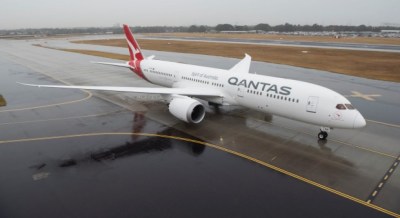
The aircraft chosen for the flight was a Boeing 787-9, fresh from the Seattle plant where the planes are built. The test flight would act as both research for Qantas’s future long-range operations, as well as serving to deliver the plane to its new owner. Normally, the 787-9 has a range of 8800 miles, carrying 280 passengers in a typical three-class arrangement.
With the distance from New York to Sydney coming in closer to 10,100 miles, sacrifices were made to reach the longer distance. The research flight, dubbed Project Sunrise, would carry just 40 passengers, along with 10 crew, including 4 on-duty pilots. These limits were in place in order to reduce the takeoff weight of the aircraft, thus reducing the fuel use and improving range. The plane also carried no cargo, and tanks were topped off before flight with 101,000 kg of fuel. The plane was expected to land with approximately 6000 kg remaining, giving 90 minutes flight time for contingencies.
Human factors were key to the ultra-long-haul operation, too. With an estimated flight time of over 19 hours, crews would need to run shifts far in excess of typical requirements. Special considerations were made to rotations, in order to ensure fatigue did not have a negative impact on crew performance. All pilots were on duty for take off and landing, sharing a series of 5 1/2 and 2 1/2 hour shifts throughout the duration of the flight. Crew were fitted with EEGs to measure brain activity, along with light monitors and physical activity monitors to determine the effects of the extended operation on the body.
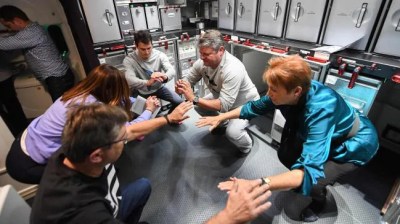
Additionally, several passengers were included in experiments to assess the impact of jet-lag when flying direct almost halfway around the world. Cabin lighting was carefully controlled to help adjust circadian rhythms as quickly as possible. Even the meals were specially prepared, with the first course featuring spicy, stimulating cuisine aimed to help flyers stay awake, while the second course featured carbohydrate-rich comfort foods to lull passengers to sleep. A special exercise regime was also included, featuring a rousing Macarena at 2AM. It’s likely this will deter some flyers, this writer included, but jet lag remains a very real problem. The difference between science and tomfoolery is writing it down, and the flight’s researchers collected data in spades. The crew went so far as to collect urine samples every four hours to measure melatonin levels, while participants’ reflexes were tested using an iPad app at intervals during the journey. Additionally, many were asked to keep sleep and activity diaries both before and after the flight for further analysis.
Smooth Sailing… If You Have Lie-Flat Seats and a Workout Area
With the utmost attention paid to every detail, it’s no surprise the flight was success. Departing at 9:30 pm from New York, the flight designated QF7879 landed at Kingsford Smith Airport, Sydney at 7:43 AM, 19 hours and sixteen minutes later. [David Slotnick] reported feeling remarkably well rested compared to a more typical long-haul flight, noting that the journey saved 3 hours and crediting the rigorous anti-jet lag regime. Meanwhile, TIME Magazine’s [Angas Whitley] noted that switching immediately to the Sydney timezone required commitment and strength of will, but that he would choose the direct flight over a layover in future, where possible.
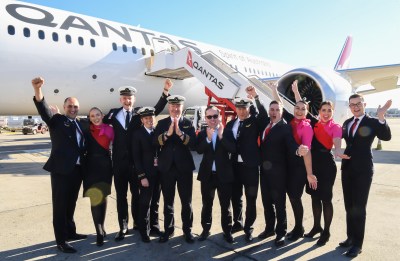
While the flight was successful as a research project, it’s likely it will be quite some time before the route is operational commercially. Project Sunrise had just 40 passengers, whom all flew in business class, complete with lay-flat seating to assist with rest. Additionally, the galley had the services of a dedicated chef for the duration of the flight, and a team of researchers attempting to make the journey as painless as possible. These luxuries cost money, and with the vast majority of the plane’s seats empty, such a flight is a long way from being commercially viable. It’s also important to contemplate the difference in experience that would be had flying over 19 hours in coach, with much reduced legroom, amenities, and no provision to sleep lying down.
Looking to the future, Qantas aims to be flying these routes with real customers by 2023. This will be enabled through new aircraft, with the Airbus A350 or Boeing 777X touted as potential candidates. To ease the struggle of such a long flight in economy seats, the airline is exploring the creation of a “common area” for passengers to exercise. This will be combined with the lessons learned from Project Sunrise, which will guide decisions around catering, lighting, and crew going forward. While the technology may not be quite there yet, it’s an exciting look at what’s just around the corner in commercial aviation.
No comments:
Post a Comment