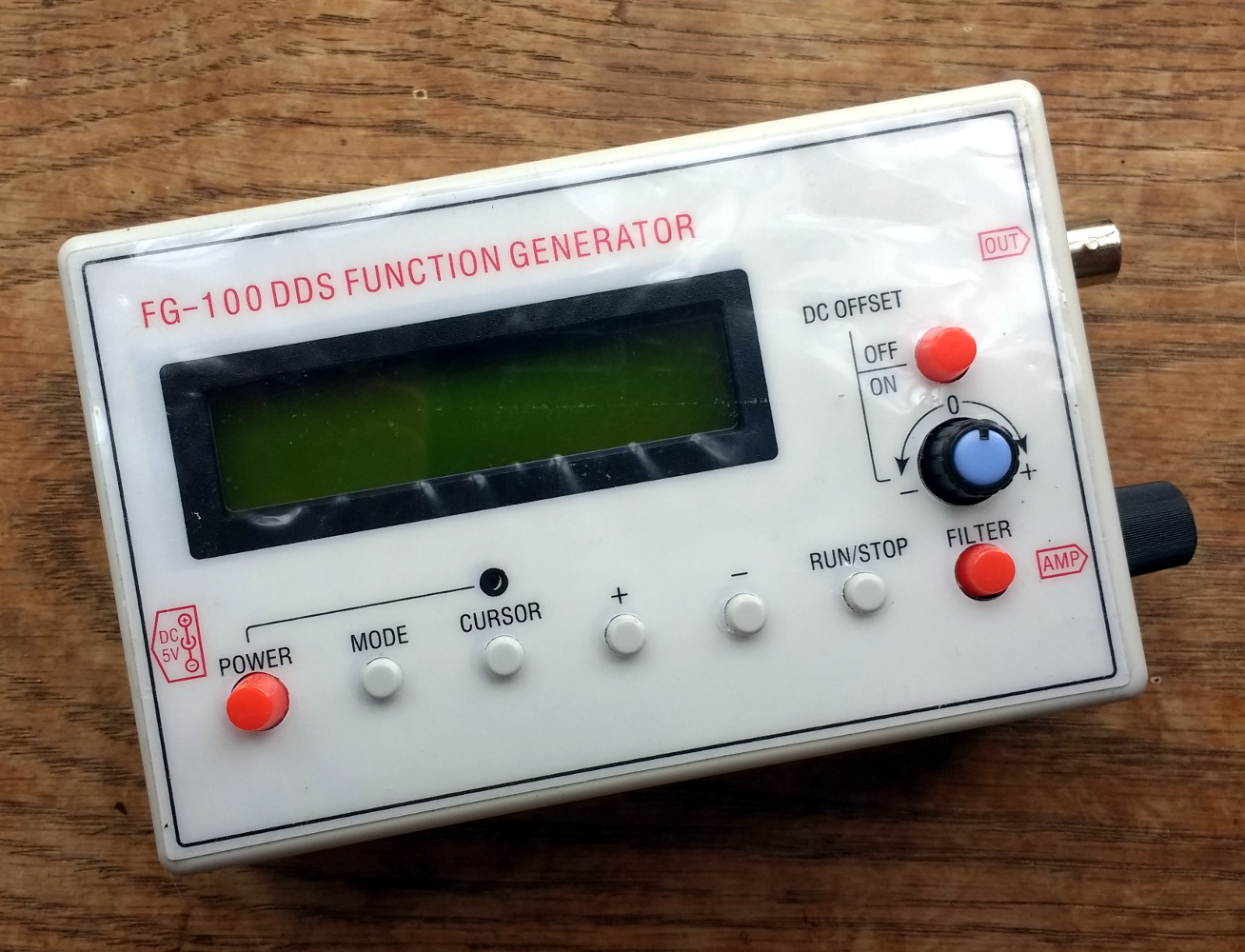
A lifetime of amassing random pieces of test equipment has left me with a gap in my armoury, namely that I don’t possess a low frequency function generator. This could easily be addressed, but for two things. I have a love for exploring the cheaper end of exported electronics and my need for a function generator is less than my desire to spend significant cash. I’ve tried to balance these competing forces in the past by picking up an astoundingly cheap instrument; that time I ended up with a lemon, but will lightning strike twice in the same spot? I spent £10 ($13) on a different cheap function generator and set off to find out.
So Good, They Forgot To Name It
I could tell my DDS function generator was a quality product when I opened the anti-static bag it came in, for whoever manufactured it wasn’t prepared to put their name to it and it has no model number I can see. Hence I’ll refer to it as the Unnamed Chinese DDS Function Generator. Jokes aside, it seems to be of a generic type that can be found from a variety of the usual online stockists. It takes the form of a PCB about 100 mm by 80 mm with one of the ubiquitous alphanumeric display modules atop it, and a couple of BNC sockets for output. Control is via a set of momentary action buttons, and there are a couple of potentiometers for level and DC offset. Finally there is a 2.1 mm barrel jack through which it will accept 7 V to 9 V DC. Surprisingly the polarity of this is unlabelled, but a quick check of the electrolytic capacitor it’s connected to revealed the centre pin to be positive.
The previous cheap function generator had been an ATmega328 with a resistor ladder DAC, and it suffered from both huge distortion and inconsistent amplitude over its frequency range. I’m not expecting this one to be on a par with a four-figure-sum signal generator, but as long as it can deliver the waveform it claims and at the same amplitude and offset across its range then I’ll be happy with it. So my first order of business was to hook up the ‘scope and see how it handles delivering a sine wave.
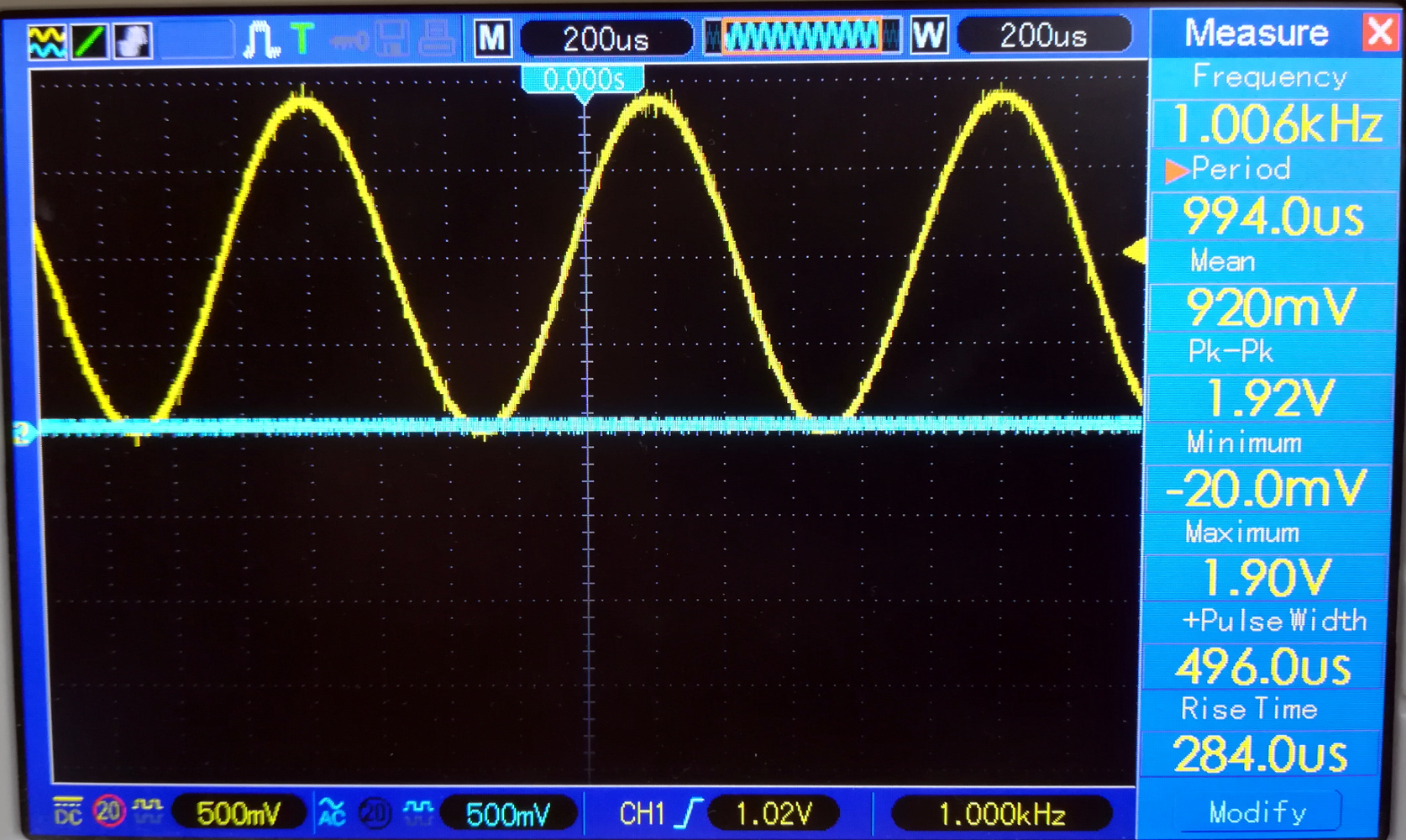
The good news is that this generator does exactly what it claims. From its 1 Hz lower end to its 65.5 kHz upper end, the sine wave shape remains the same and the amplitude and offset I selected on the two potentiometers is consistent. The other waveforms are the same, square, triangle, sawtooth, random noise, and unexpectedly, an ECG waveform that looks super realistic at 1 Hz with a 200 mS timebase. Is that in there for novelty film props? There is also a separate higher frequency square wave output that can deliver between 1 MHz and 8 MHz at logic levels.
So it’s a capable little function generator, but where is the bad news? As you’d expect from a £10 outlay it’s not quite a perfect function generator. At the higher frequencies its sample step becomes visible on the ‘scope, but most annoyingly in operation, the potentiometers lack a fine control. Getting an amplitude and offset right on the mark can be a frustrating process. Still neither of these come as a game over moment for such a cheap instrument, even with them it will suffice for my needs.
What Powers This Unexpectedly Useful Instrument?
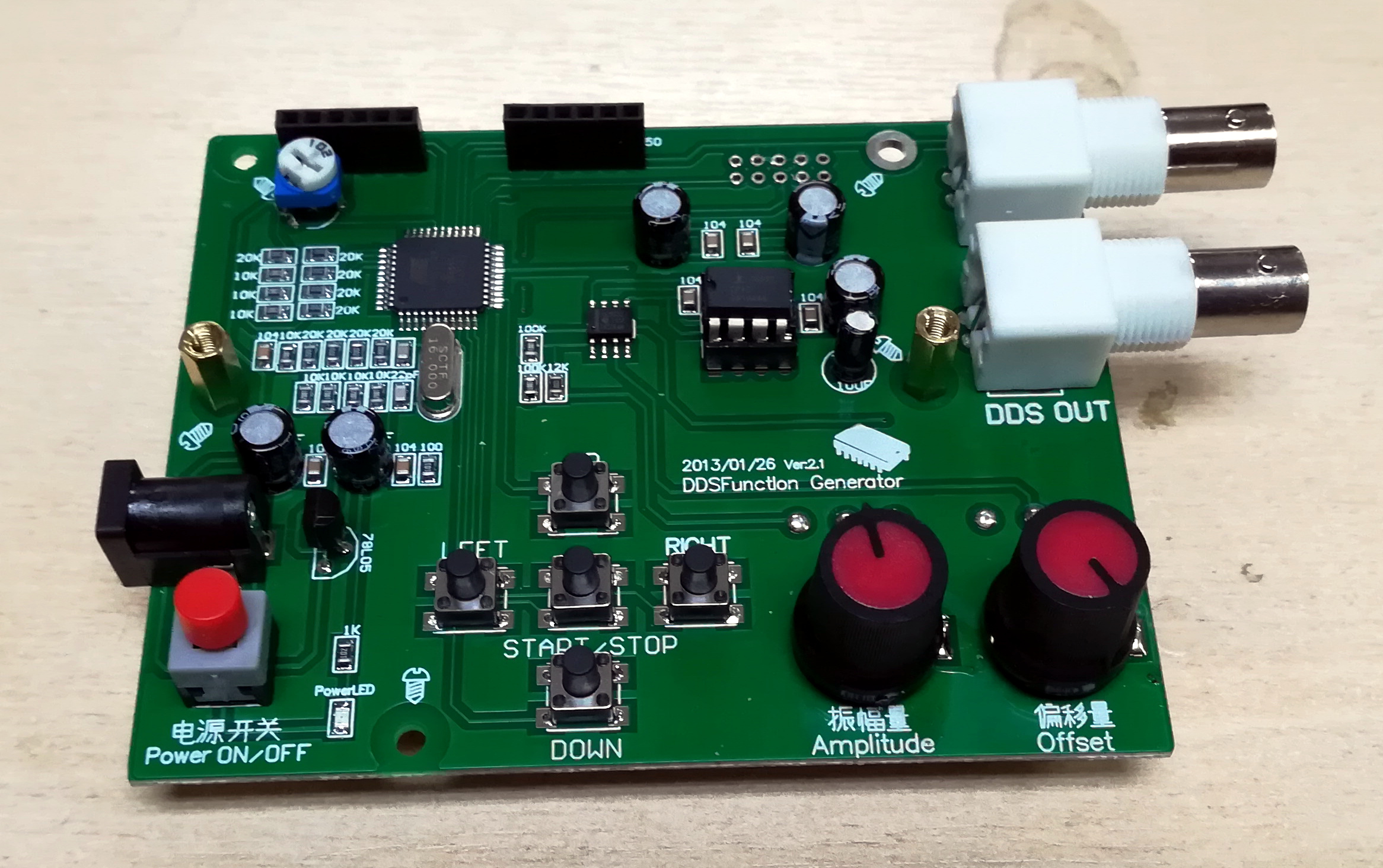
Undoing the two screws to remove the LCD, and the device’s inner secrets are laid bare. At its heart is an ATmega16 with an R/2R resistor ladder DAC made with an array of 10 kΩ and 20 kΩ resistors, and following that is an NE5532 dual op-amp that presumably handles the amplitude and DC offset. Finally there is an ICL7660 switched-capacitor voltage doubler unexpectedly in a socketed DIP-8 package, at a guess to give enough DC overhead to provide the range of output voltages. Otherwise the only semiconductor is a 78L05 voltage regulator, making it a surprisingly simple device.
In conclusion then, should you spend your tenner on this function generator? Being honest, I splashed out on it half in the expectation of another entertainingly bad piece of junk to amuse you with, and was instead pleasantly surprised to receive a unit that works as expected and delivers exactly what I need from a cheap function generator. In that case it’s a definite diamond in the rough, and should you need an audio function generator and don’t mind a few shortcomings then you should certainly give it a look.
No comments:
Post a Comment