As a budding automotive enthusiast, you finally took the plunge and scored yourself a sweet project car. After going through it from top to toe, you’ve done your basic maintenance and it’s now running like a top. Now you’re getting comfortable, you’ve set your sights on turning your humble ride into a corner carving machine. Here’s a guide to get yourself started.
It’s All About Grip
When it comes to creating a handling monster, the aim is to create a car that sticks to the road like glue, and is controllable when it does break loose. Having a car that handles predictably at the limit is a big help when you’re pushing hard on track, particularly for an inexperienced driver. And, whether you’re hitting the canyons on the weekend or trying to slash your laptimes, it’s always nice to have more grip. Through selecting the right parts and getting the set up right, it’s possible to hone your car’s cornering ability to make it a rewarding experience to drive fast and hard.
Wheels and Tires

No other part on your car has as much effect on handling as your wheels and tires. No matter your suspension set up, no matter what you’ve done under the hood, it all comes to naught if you’re driving around on bald, slippery tyres. Your tyres are what connects the car to the road, and thus it’s the first place you should look to upgrade when you want to go faster in the bends.
There’s a few factors that come into play when selecting wheels and tyres. You’ll want a set of wheels that are nice and wide so you can fit fat tyres with plenty of grip; however, your car’s geometry and guards will limit how far you can go here. High-powered track builds will often go as far as cutting sheet metal and fitting overfenders to fit wider rubber, while lower-powered builds can often get by without such extreme measures. Wheel diameter is dependent on your car’s suspension setup. Most cars have a certain wheel size that is the best tradeoff between performance and having a good selection of tyres to choose from. Early Miatas do great with 15″ wheels, while an RX-7 is more at home on 17″ or 18″, for example.

Weight also plays a big role. Wheels and tyres count as unsprung weight – the weight that is not supported by the suspension components. Reducing this weight makes it easier for the suspension components to do their job of keeping the tyres in contact with the road, thanks to lower inertia. Additionally, they’re also rotational weight, and reducing this helps the car accelerate and decelerate more quickly. Lightweight wheels are expensive, but performance gains can be significant. Serious track fiends will spend big money on a set of lightweight forged wheels, with even lighter carbon fibre items slowly entering the mainstream at even higher prices.
Tyre compound is important, too, and depends on how you’ll be using the vehicle. For street use with the occasional track day, a performance road tyre is best – think the Hankook Ventus RS4 or Michelin Pilot Sport 4. If you’re looking for super-sticky race tyres that you can still drive on the road to get to the track, consider a semi-slick like the Nankang AR-1. Alternatively, if you’re trailering your car to events, you can go for an all-out racing slick. Don’t use semi-slicks or slicks for normal driving duties, though – they’re dangerous in the wet and will wear out incredibly rapidly! Of course, if you’re in the rally game, you’ll be eyeing specialist mud or gravel tyres instead.
Wheel and tyre upgrades are often the cheapest way to make big gains in laptime at the track. Without good tyres gluing you to the road, any other mods you do will be far less effective, so it pays to do this first.
Shocks And Springs
Likely the next area you’ll want to consider is upgrading to a better set of shocks and springs. Typically, cars come with a setup that balances comfort and handling. Often, enthusiasts are willing to sacrifice the former to get more of the latter.
One option is to source a set of lowering springs to drop the ride height of the car. This lowers the center of gravity which helps improve handling, with the drawback of making bumps and potholes more difficult to deal with. Often, such spring will be stiffer than stock to help keep the tyre in contact with the road better, albeit at the cost of a harsher ride. Such modification is often done in concert with a set of performance shock absorbers designed for the lower ride height. This is a good choice for drivers looking for better handling without compromising too much day-to-day drivability.
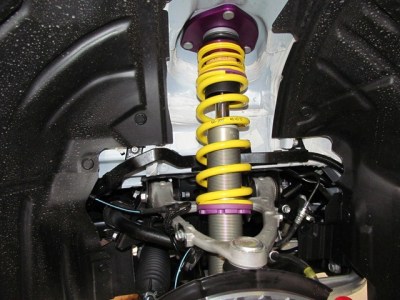
Alternatively, a more popular option on modern cars is to switch to a coilover setup. This is most common on Japanese cars, where the coil spring is placed over the shock absorber in a single assembly. Coilover setups often come with adjustable ride height and damping, allowing the car to be set up with a more aggressive alignment. Camber plates can usually be added too, further improving adjustability – useful when trying to dial in the ultimate setup for race applications. The trade-off is that usually, coilover setups are aimed at more serious track use, and can give quite a harsh ride on the road. However, they make a great choice for those spending plenty of time at track, chasing every last second of laptime.
Swapping out shocks and springs is a good way to hone your car’s handling, but it’s also an easy way to ruin your car, too. It’s important to buy quality parts and understand the effect they’ll have on your car. A $200 set of eBay coilovers, for example, will do little more than make your car handle like a brick on wheels. A $3,000 set of Ohlins race shocks will do great at the track, but may be a little much for going down to the shops. And those lowering springs you scored off Craigslist might have eliminated your car’s body roll, but you’ll struggle to get in and out of your sloped driveway. The key is to improve your handling without going too low, or too stiff, and ruining your ride.
Sway Bars
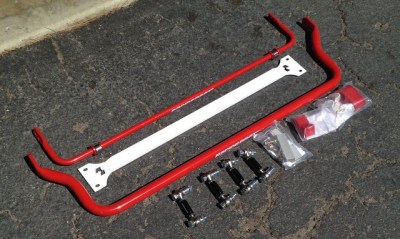
Sway bars are components that connect the left and right suspension components to help reduce body roll. They’re not fitted to all cars, but are relatively common and have a big effect on handling. Installing stiffer sway bars can help reduce body roll which can be disconcerting during fast cornering.
Additionally, they can be used to dial in the oversteer or understeer characteristics of your vehicle to your liking. Installing a stiffer front swaybar or a softer rear swaybar can help reduce oversteer, while installing a softer front swaybar or a stiffer rear swaybar can reduce understeer. They can also be removed entirely where applicable.
Aftermarket swaybars are available for most cars that have sporting pretensions. It’s a good area to consider tweaking when you’ve begun to find the weaknesses of your setup after doing some basic upgrades. If you’re upgrading to a set of aftermarket sway bars, you’ve probably already lowered your car with a set of shocks and springs, and so scoring a set of adjustable end-links will help you get things installed just right. Skipping this step and using stock swaybar links can lead to problems with pre-loading the bar, and can make installation difficult. Additionally, some cars need extra bracing when installing uprated bars; be sure to research common setups for your vehicle to avoid nasty surprises.
Bushings
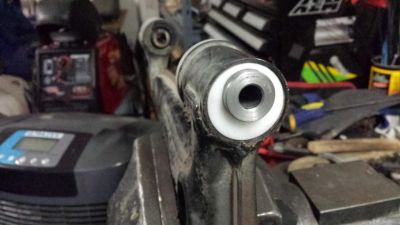
Bushings are the stiff, yet flexible components that connect parts of your suspension together. Usually, stock bushings are made of rubber, with a steel sleeve in the middle to locate bolts and allow movement in your suspension components. They serve to help isolate road vibrations from the rest of the car and act as another damping mechanism in your suspension system.
If you’ve got a project car that’s over 20 years old, it’s likely that the factory rubber bushings have grown tired and are beginning to perish. Replacing them with a fresh set can help reduce play in your suspension and steering, and make your car feel like new again.
However, there are upgrade options, too. It’s often possible to order aftermarket bushes made from polyurethane instead of rubber, which can help sharpen handling up significantly. This is due to the greater stiffness of the polyurethane material. The drawback is that often, these bushes can squeak if not greased regularly, making them a pain for regular road use. For some popular sports cars, like the Mazda Miata, it’s possible to instead source aftermarket bushes that are still rubber, but stiffer than stock. These can be a good choice of those wanting an upgrade in performance without dealing with the headaches of polyurethane bushes.
Setup And Alignment
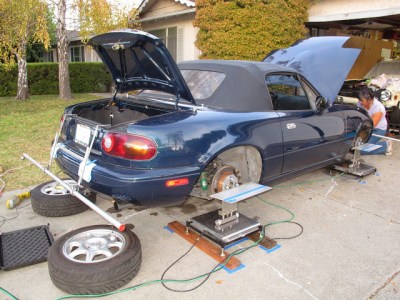
So, you’ve thrown a whole bunch of parts at your car, and now you’re ready to go faster, right? Wrong. It’s one thing to fit upgraded suspension components, but without the right setup, you’re going to have a bad time. Between adjustable dampers, camber, toe, and spring rates, there’s a lot you need to get right to keep your car pointed in the right direction.
For the novice, this is where it’s crucial to learn from the experts. Finding a local alignment shop that’s comfortable working on modified vehicles is key; your local Lube ‘n’ Tyre isn’t really up to the job here. They’ll be able to help guide you with the right alignment settings to give you sharp turn-in and predictable handling. They’ll also be able to give you tips on how to set your dampers and whether you’ve got enough tyre for the job. Other great sources of informations are forums and car clubs – other owners with similar vehicles will gladly tell you how to set up your car properly. They’ll tell you not only what parts are good, but how to get the most out of them by getting your setup right.
A great practical example is the SuperMiata alignment page. With the original Mazda Miata being one of the most popular track cars of the last three decades, there’s a huge wealth of knowledge on how to get the best out of the vehicle on track. The page describes several different alignment setups, along with their intended use and what other parts or modifications are necessary to make it work. It’s a useful resource for those new to customizing a car for handling gains. Similar resources exist for many popular cars. Failing that, it never hurts to ask around your local club or alignment shop!
It’s All About Compromise
When you’re choosing parts for your project car, it’s all about doing the right research and deciding what trade-offs you’re willing to make. The choices you’ll make for an all-out track car are different than those for a weekend canyon carver that still needs to get you to work on Monday.
While these recommendations won’t win you a national title in your first year, they’re a great place to start for the beginner. Swapping out these parts is mostly achievable in the garage at home, without too many expensive tools. Through observing what parts others have used in their builds, it’s easy to get an idea of what parts you’ll want to achieve your goals. Good luck slashing those laptimes, and happy hacking!
No comments:
Post a Comment