Air-to-air combat or “dogfighting” was once a very personal affair. Pilots of the First and Second World War had to get so close to land a hit with their guns that it wasn’t uncommon for altercations to end in a mid-air collision. But by the 1960s, guided missile technology had advanced to the point that a fighter could lock onto an enemy aircraft and fire before the target even came into visual range. The skill and experience of a pilot was no longer enough to guarantee the outcome of an engagement, and a new arms race was born.
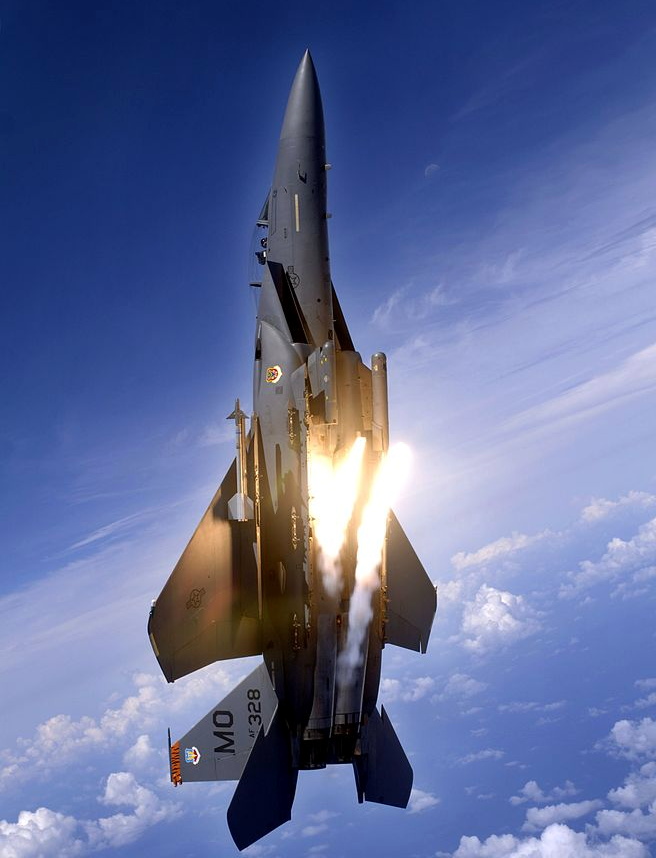
Naturally, the move to guided weapons triggered the development of defensive countermeasures that could confuse them. If the missile is guided by radar, the target aircraft can eject a cloud of metallic strips known as chaff to overwhelm its targeting system. Heat-seeking missiles can be thrown off with a flare that burns hotter than the aircraft’s engine exhaust. Both techniques are simple, reliable, and have remained effective after more than a half-century of guided missile development.
But they aren’t perfect. The biggest problem is that both chaff and flares are a finite resource: once the aircraft has expended its stock, it’s left defenseless. They also only work for a limited amount of time, which makes timing their deployment absolutely critical. Automated dispensers can help ensure that the countermeasures are used as efficiently as possible, but sustained enemy fire could still deplete the aircraft’s defensive systems if given enough time.
In an effort to develop the ultimate in defensive countermeasures, the United States Navy has been working on a system that can project decoy aircraft in mid-air. Referred to as “Ghosts” in the recently published patent, several of these phantom aircraft could be generated for as long as the system has electrical power. History tells us that the proliferation of this technology will inevitably lead to the development of an even more sensitive guided missile, but in the meantime, it could give American aircraft a considerable advantage in any potential air-to-air engagements.
Looking the Part
At first blush, the idea sounds like something from science fiction. Volumetric holograms projected into thin air have been the Holy Grail of display technology for decades, and the idea that the Navy has developed the concept far enough that they can bolt it to the back of an aircraft might come as something of a shock. But the important distinction here is that the projection isn’t trying to fool human eyes. It’s probably best to think of the projection as a solid-state replacement to the traditional flare: the idea is create a mass of plasma in the air that is emitting enough energy at the appropriate wavelengths that it would distract from the physical aircraft it’s being projected from.
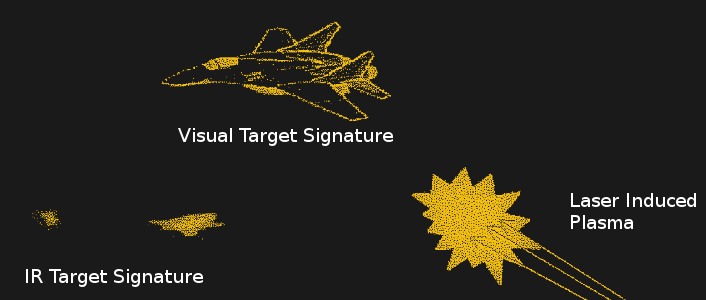
But that doesn’t necessarily mean the projection will be an amorphous blob, either. The patent specifically mentions that the system’s 248 nm krypton fluoride (KrF) laser could be paired with mirrors and raster optics to create 2D and 3D volumetric images in space. It goes on to compare the technique with the way images were drawn with a scanning electron beam in a cathode-ray tube television.
So while the projection wouldn’t visibly resemble an actual aircraft, it could be given a three dimensional shape to better approximate a jet engine or fuselage. This is a critical improvement over traditional countermeasures, as more advanced guided missiles such as the AIM-132 now include thermal imaging technology that can differentiate between a hot “point source” like a flare and the more nuanced shape of an aircraft.
Laser Light Show
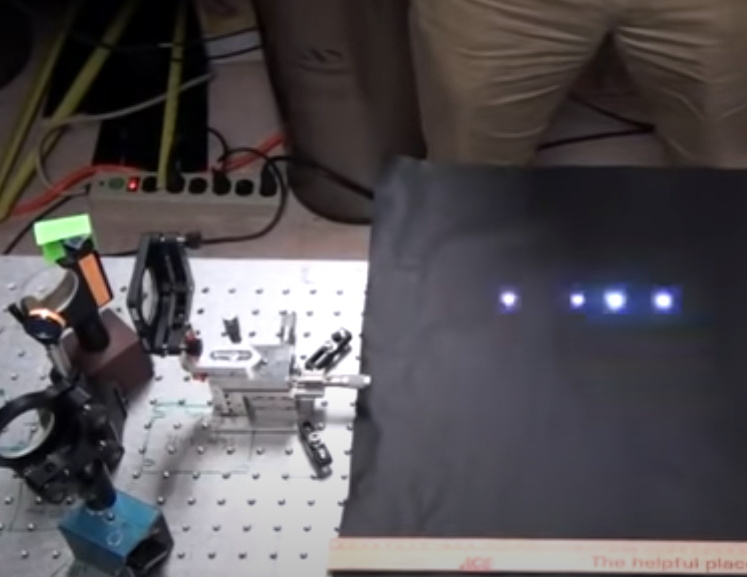
As it so happens, the technology to project relatively simple geometric shapes in the air with a laser isn’t exactly new. A Japanese company demonstrated using laser-induced plasma balls as “pixels” in a rudimentary display as early as 2011, with plans to use it for advertisements and emergency notifications. While the technology offered limited resolution, it was more than sufficient to draw shapes and text that were visible even in daylight.
The concept is also very similar to a research being conducted by the Department of Defense into open-air plasma speakers. Developed as part of the Joint Non-Lethal Weapons Program, the light and sound produced by the plasma ignition was envisioned as a way to stun or confuse a target. One demonstration even showed how the plasma ball could be modulated in such a way that they could emit an audible warning message.
Phantom Fliers
Looking at existing laser-induced plasma experiments, the Navy’s idea suddenly seems a lot more reasonable. While packing a powerful enough laser and associated optics into a package small enough to mount to a fighter jet may still be a few years away, it seems clear that the concept itself is sound.
The advantages of such a system over traditional flares are considerable. As already mentioned, this type of countermeasure wouldn’t be consumable; so long as the turbines are spinning and the plane has sufficient electrical power to operate the laser, the projection can remain active. Another key improvement is that the plasma decoy will actually follow the aircraft as it flies. Flares and chaff are quickly left behind, but these ghosts would be able to maintain a set distance from the aircraft throughout the entire mission.
So what happens when aircraft are able to project plasma ghosts behind them that make them invulnerable to heat-seeking missiles? It seems the next logical step would be to develop missiles that use visual identification for terminal guidance. At that point you’d need an emitter that can project a decoy that actually looks like a real airplane, in which case we might actually get that fabled holographic display technology before too long.
No comments:
Post a Comment