Many cities around the world routinely struggle with smog. Apart from being unsightly, heavy air pollution has serious negative health effects, both in the short term and with regards to long-term life expectancy. Over the years, governments have tried to tackle the problem with varied tactics around the world.
When talking about smog, Brussels is not one of the cities that comes first to mind. Regardless, the local government has developed its new climate plan that seeks to abolish fossil fuel vehicles from its streets by 2035. The scheme has a variety of measures that will be staggered over the coming years. It’s part of a broadening trend in transportation, and something we’ll likely see more of around the world in coming years.
What’s The Go?
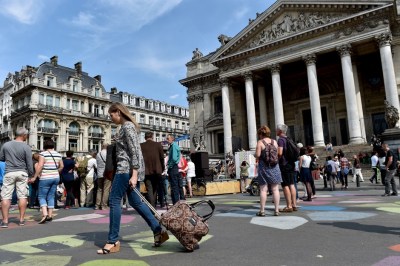
Under the new plan, diesel vehicles will be banned from the city’s Low Emission Zone, or LEZ, by 2030. This will further extend to gasoline vehicles in 2035. Furthermore, special categories of higher polluting vehicles will have bans enforced even earlier. Motorcycles had previously been exempt from the LEZ, but moving forward, the most polluting models will be locked out of the city centre as soon as 2022. The aim is to reduce emissions, with a goal of cutting CO2 output by 40 percent by 2030, and becoming carbon neutral by 2050. The city is also exploring the concept of a Zero Emission Zone, or ZEZ, expanding upon earlier efforts which transformed the Boulevard Anspach from a heavily-trafficked road into a pedestrian-only plaza.
We’ve Seen This Before
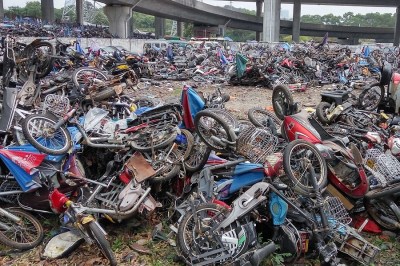
Similar bans have been made in other jurisdictions. One of the most well-known bans was enacted in China, which began banning gasoline motorcycles from its largest cities well over a decade ago. This led to commuters switching over to electric bikes and scooters in droves, which were free to navigate the city unhindered. These vehicles were also free of any licencing or registration restrictions. Eventually, a new kind of chaos reigned, as cities were swamped with poorly behaved riders causing large numbers of crashes across cities. Electric bikes were summarily banned from several areas, despite the benefits of the otherwise cheap and clean transport.
Electric bikes have become a contentious issue, with government decrees landing many thousands of the vehicles on the scrapheap. Regardless, China continues to push forward with electric cars in a big way. The world’s largest maker of electric vehicles is Shenzhen-based BYD, and China is the biggest market for the electric car. Over 500,000 electric buses ply the streets, and many thousands of taxis now run solely on electric power. This huge shift has been largely due to government regulation, which shifts fast in the single-party state. Prospective owners of gasoline cars have to compete in lotteries or auctions to win a licence plate in big cities, while so-called New Energy Vehicles receive a plate for free. The country is mulling a total ban on combustion-powered vehicle sales, though has not yet set a deadline for the changeover.
Other countries are moving in similar directions. Denmark aims to ban the sale of diesel and petrol vehicles by 2030, with hybrids banned by 2035. France aims to outlaw the sale of fossil-fuel vehicles by 2040, with the United Kingdom looking at a similar timeline. Sri Lanka aims to eliminate combustion-engined vehicles in state ownership by 2025, with a private ownership ban by 2040. In many cases, these measures are being created with an eye to also enacting similar clean-air zones, with outright bans or taxes on polluting vehicles that wish to enter the area.
Local governments are eager to push these measures which promise a series of beneficial flow-on effects. High levels of nitrogen oxides as well as particulate pollution cause respiratory health problems,leading to thousands of deaths worldwide. Reducing these numbers helps bring down healthcare costs, and improves the habitability of public spaces. There are other secondary-level benefits too, as a switch away from fossil fuels promises to take thousands of tanker trucks off the roads, further helping to reduce congestion and emissions.
Options to Consider
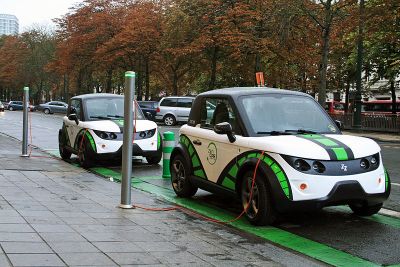
Owners of internal combustion vehicles will have some time to contemplate their options going forward. For those with a classic car collection and deep pockets, electric conversions may be an option. However, for the average commuter car, this is rarely cost effective. Motorcycle riders will likely be similarly left out in the cold, with the handful of conversion kits on the market requiring a high level of DIY skills and equipment to execute. Hackers will always make their own, but it’s unlikely to become a solution for the average motorist anytime soon.
Instead, the measure is likely to push commuters to look into purchasing newer, more efficient vehicles. The slow, staggered rollout of the ban gives drivers several years to prepare, helping to gradually switch drivers over to cleaner technologies, without requiring otherwise usable cars to be scrapped overnight. It also creates a natural incentive for the community to consider electric vehicles, helping drive money into the industry to fund further research and development. Policymakers hope that this will snowball, allowing automakers to improve vehicle range and charging speeds, making electric vehicles yet more attractive to potential customers.
Going forward, it’s likely to see more cities and entire countries progress towards fossil fuel phaseouts and no-go zones for polluting vehicles. The gains to be had in reducing smog and pollution are too good to ignore for many municipalities. It’s also a much more flexible tool that can cost less than simply placing large subsidies on clean vehicles, which can be unpopular with lobbyists and constituents alike. Such legislation also helps give confidence to companies contemplating investments in necessary hardware, such as the electricity grid and charging infrastructure. As consumers begin to pour more money into the electric vehicle market, the technology will also begin to outcompete traditional fossil fuel cars. Expect to see similar legislation rolling out in forward-thinking cities around the world, and the electric car takeover to continue to gather pace in the coming years.
No comments:
Post a Comment