You may remember that I collect slide rules. If you don’t, it probably doesn’t surprise you. I have a large number of what I think of as normal slide rules. I also have the less common circular and cylindrical slide rules. But I recently picked up a real oddity that I had to share: the Smarty Cat. It isn’t exactly a slide rule but it sort of is if you stretch the definition a bit.
Real Slide Rules
A regular slide rule takes advantage of the fact that you can multiply and divide by adding logarithms. Imagine having two rulers marked in inches or centimeters — it doesn’t matter (see the adjoining image). Suppose you want to add 5 and 3. You count off 5 marks on one ruler and line it with up the zero inch mark on the other ruler. Now you count off 3 marks on the second ruler and that position on the first ruler will indicate the result. Here it lines up with the 8 mark, which is, of course, the correct answer.

That’s a simple addition. But if you can convert your numbers into logarithms, add the logarithms, and then back out to a regular number, you can multiply.
Logarithms and Slide Rules
Let’s try a multiplication example: 10 times 100. Using base 10 logarithms, the marks on the ruler will be 1 and 2 (because 101=10 and 102=100). If you add 1 and 2 you get 3 and 103 is, in fact, 1000 which is the right answer. That’s how a normal slide rule works. There’s a cursor (a clear plastic slide) that rides over the rulers so you can precisely tell where the rules line up.
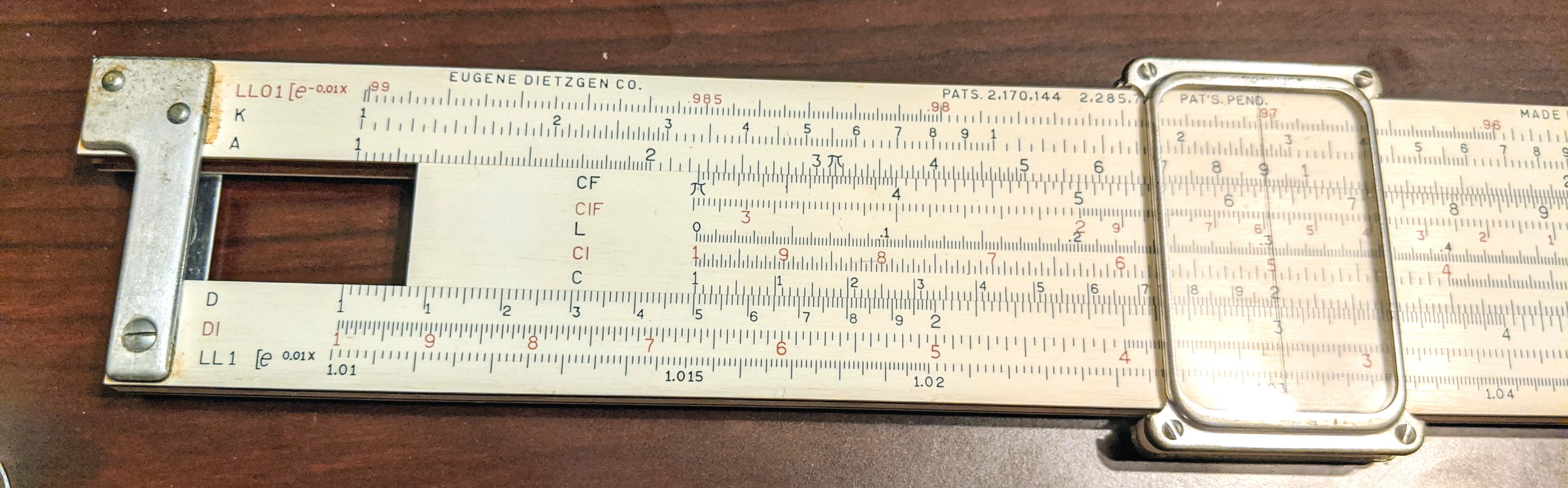
Look at the scales on the rule in the picture. See the 1 on the C scale? That’s the same as zero in the simple illustration above because 100=1. It lines up to 1.5 on the D scale (or 15, or 150; they are all the same). Now look under the crosshair on the cursor. The 2 on the C scale lines up with the 3 on the D scale. That means that 1.5 x 2=3. It also means 1.5 x 20=30, 15 x 2.0=30, and 15 x 20 = 300, among other things. There’s nothing magic about the cursor. If you look a bit to the right, you can see that 1.5 x 1.3=1.95, and 15 x 1.3=19.5.
Smarty Cat
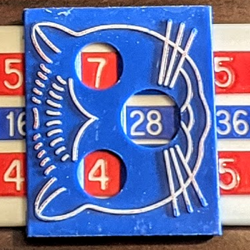
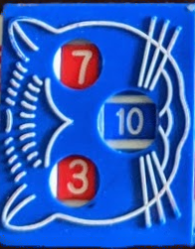
The Smarty Cat is very different, yet it can add, subtract, multiply, and divide small integers. The Cat is more like a single ruler with three scales on each side of the ruler. None of these scales ever move. However, there is a cursor that appears like a cat’s face — it isn’t transparent, but there are holes for the cat’s eyes and nose. The scales are such that when two numbers show up in the eyes, the number under the cat’s nose will be the sum of the other two numbers. It also means that the number under the nose minus one of the eye numbers will equal the other eye number. The photo shows 7 + 3 = 10, for example.
The other side of the rule has a different arrangement of numbers. On that side, the two eye numbers multiplied together give you the number under the nose. By the same token, the nose number divided by either eye number will result in the other eye number. That is if you look in the photograph, 7 x 4 = 28. Of course, 28/7=4 and 28/4=7.
Calculator
By today’s standards, this isn’t much of a calculator. Still, it is pretty ingenious how people figured out ways to automate math before we had computers. While I’ll admit it isn’t really a slide rule in the classic sense, it is still a pretty fun collectible.
I’ve talked about regular slide rules before. I’ve even argued that the death of the slide rule has hurt the quality of engineering graduates. We’d love to hear your thoughts, and see some of the more interesting slide rules you have in your collection, in the comments below.
No comments:
Post a Comment