Neutrinos are some of the strangest particles we have encountered so far. About 100 billion of them are going through every square centimeter on Earth per second but their interaction rate is so low that they can easily zip through the entire planet. This is how they earned the popular name ‘ghost particle’. Neutrinos are part of many unsolved questions in physics. We still do not know their mass and they might even be there own anti-particles while their siblings could make up the dark matter in our Universe. In addition, they are valuable messengers from the most extreme astrophysical phenomena like supernovae, and supermassive black holes.
The neutrinos on earth have different origins: there are solar neutrinos produced in the fusion processes of our sun, atmospheric neutrinos produced by cosmic rays hitting our atmosphere, manmade reactor neutrinos created in the radioactive decays of nuclear reactors, geoneutrinos which stem from similar processes naturally occurring inside the earth, and astrophysical neutrinos produced outside of our solar system during supernovae and other extreme processes most of which are still unknown.
The Largest Detector Ever Built
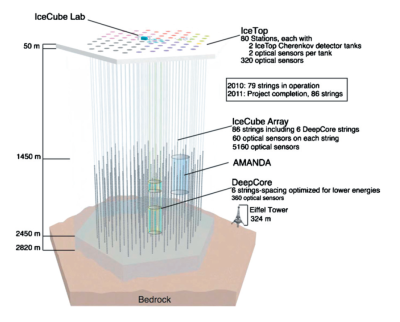
Credit: – IceCube Science Team – Francis Halzen, Department of Physics, University of Wisconsin, CC BY 3.0
Because neutrinos have no charge and are only affected by the weak interaction (and gravity) they are hard to detect. Some experiments use large tanks filled with pure water and equipped with light sensors as detectors. Neutrinos can knock out electrons from the water molecules that will travel faster than the speed of light in that medium and thereby produce Cherenkov light, which is also responsible for the healthy blue glow that emanates from nuclear reactors. The IceCube experiment takes advantage of this detection method on a much larger scale. Instead of building a huge water tank, they buried 86 strings equipped with a total of 5,160 light detectors up to 2,500 m deep in the Antarctic ice. The total volume of the detector is one cubic kilometer which corresponds to a target mass of one gigaton and is thus the largest detector ever built.
Neutrinos from Supermassive Black Holes
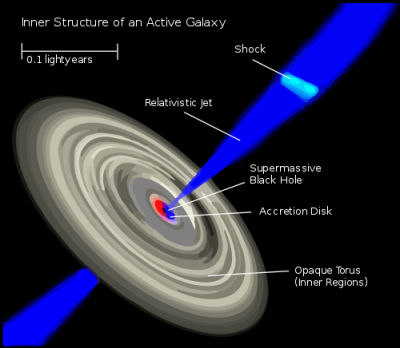
Credit: Rothwild, CC BY-SA 3.0
A great success of IceCube was the first detection of high-energy astrophysical neutrinos in 2013. Before that, the only neutrinos from astrophysical sources outside our solar systems were detected during a supernova in 1987. At the time of the IceCube observation, it was not clear where these neutrinos originated but this changed in 2017 when another high-energy neutrino event could be attributed to a known gamma-ray blazar. A blazar is formed by an active galactic nucleus (AGN), the center region of a galaxy that is theorized to house a supermassive black hole. Mass falling into the black hole produces a pair of relativistic jets that can be seen as a bright source throughout the electromagnetic spectrum when they are directed towards the observer. Recently, Russian researchers made another progress in identifying the sources of astrophysical neutrinos. They compared the IceCube events with data from a network of radio telescopes and found them to be associated with several radio-bright AGNs. Multimessenger astronomy like this is a striving field that became even more interesting since we added gravitational waves to the game. To enable the coincidental observation of neutrinos, electromagnetic radiation, cosmic rays, and gravitational waves from astrophysical sources, different telescopes around the world are joined by the Astrophysical Multimessenger Observatory Network (AMON)
Neutrino Detection with Radio Pulses
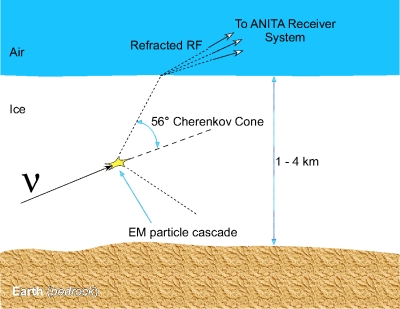
Credit: The ANITA collaboration
IceCube is not the only neutrino experiment at the south pole. The Antarctic Impulsive Transient Antenna (ANITA) is a balloon-borne experiment designed to detect radio waves created by very high-energy neutrinos smashing into the ice, known as the Askaryan effect. ANITA detects radio pulses that travel upwards in the atmosphere as they are produced by neutrinos traveling through the earth. An upwards going radio pulse can also be produced by cosmic rays coming from above when the signal is reflected off the surface of the ice, however, during reflection it changes polarization. ANITA can therefore distinguish these radio pulses by looking at the phase of the detected signal.
An Unexpected Signal
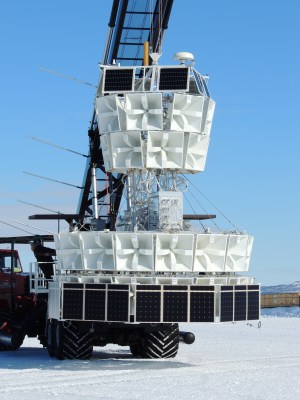
Credit: Drummermean, CC BY-SA 4.0
The experiment made the headlines when they detected two anomalous events during two separate flights in 2006 and 2014. Both events were consistent with upwards propagating radio pulses produced by neutrinos traveling through the earth. The problem was that the measured arrival angles and energies of the neutrinos were much higher than the expected neutrino flux. The neutrinos must have traveled through more than 5700 km earth and had energies of ~0.5 EeV. Since we know the flux of neutrinos at these energies from other experiments but also from ANITA itself and their interaction rate, there was simply no way that they could have survived traveling through that much rock.
A possible explanation was that the neutrinos came from an intense point source. Some kind of cosmic accelerator, like a supermassive black hole, which shoots out a narrow beam of high energy neutrinos. This explanation was disproven earlier this year by the IceCube collaboration which conducted a search for such point sources in the direction of the ANITA events but found nothing. If the two ANITA events would have originated from a point source, IceCube should have detected many more, which they did not.
The only two remaining explanations for the anomalous events were some systematic error or new physics. In fact, when the ANITA result first came out one collaboration member jumped the gun and tweeted that he thinks they just broke the Standard Model of particle physics. This is typical behavior for scientists who are under the impression that they unexpectedly made a great discovery and you cannot really blame them for getting overexcited. However, in many cases, it leads to embarrassment when the result turns out to be just a fluke. Some recent examples for this include the false detections of superluminal neutrinos and gravitational wave signatures in the cosmic microwave background.
When Tabloids Interpret Physics
In April New Scientist published an article about the ANITA anomaly where they cited an older paper from 2018 by another group of theoretical physicists that interprets the events as evidence for a theory where our universe is the mirrored image of another universe that existed before the big bang. The story was immediately picked up by several tabloids like the UK Daily Star under the headline
“NASA scientists detect parallel universe ‘next to ours’ where time runs backwards”
One can immediately see what is wrong with this headline. Firstly, it connects NASA who is founding ANITA with the theory paper by an entirely different group. Secondly, it pretends as if the theory was a fact instead of being merely one of many interpretations of the data and even not a very likely one. ANITA researchers from the University of Hawaii were evidently annoyed by the false media coverage and issued a press release to clarify that they are in no way affiliated with the theory paper about the parallel universe. One has to point out that the theory paper was written by respectable physicists and should not be regarded as shady.
This is definitely not the first time though that the media has taken scientific speculation at face value. The discovery of dark matter, e.g., was falsely announced several times by major news stories over the past years, whenever an experiment published a result that contained some unexplainable events. Like the ANITA researchers, also in these cases, scientists were very careful not to make any claim of discovery in their publications. Usually, this requires confirmation by another experiment, like the discovery of the Higgs boson had to be seen by both ATLAS and CMS detectors. Journalists are less careful about making such claims as it simply makes for better headlines.
So what is the most likely explanation for the ANITA result? There are numerous papers that try to explain the events with beyond-the-standard-model physics scenarios but some people have also proposed more mundane solutions. One group of researchers has pointed out that radio signals reflected slightly below the ice surface can occur without phase inversion. There is also a possible explanation due to the interaction of cosmic rays with the Earth’s magnetic field. Future experiments like the proposed Payload for Ultrahigh Energy Observations (PUEO), the successor to the ANITA program, may shed some more light on this matter. In addition, the ANITA collaboration is still analyzing the data from their latest flight, and we are eagerly awaiting the results.
Banner image: University of Madison-Wisconsin.
No comments:
Post a Comment