After getting a 3D printer up and running, it’s not uncommon for an enterprising hacker to dabble in 3D printing to make a little money on the side. Offering local pickup of orders is a common startup choice since it’s simple and avoids shipping entirely. It’s virtually tailor-made to make a great bootstrapping experiment, but anyone who tries it sooner or later bumps up against a critical but simple-seeming problem: how to get finished prints into a customer’s hands in a sustainable way that is not a hassle for either the provider, or the customer?
It’s very easy to accept a 3D file and get paid online, but the part about actually getting the print into the customer’s hands does not have a one-size-fits-all solution. This is what I call The Pickup Problem, and left unsolved, it can become unsustainable. Let’s look at why local pickup doesn’t always measure up, then examine possible solutions.
The Problems with Local Pickup
Local pickup for delivery of print jobs is great because there is no mucking about with shipping supplies or carriers. Also, many 3D prints when starting out will be relatively low-value jobs that no one is interested in stacking shipping fees onto, anyway.
“Your order is complete. Come to this address to pick up your order.” It is straightforward and hits all the bases, so what’s the problem?
For a business with a staffed physical location, there’s no problem! But if you are an enterprising hacker trying it as a side gig, it is lacking in several important ways.
Schedules Need To Match Up
You need to be home for local pickup to work. Customers will understandably expect to be able to pick up their order at their own convenience, but your schedules will need to match up for it to happen. Any time you are not home and available to answer the door, local pickup won’t work and that brings us to the next issue.
 Scaling and Sustainability
Time and focus are your most precious resources, but committing to making yourself available for local pickups can have an impact on your life and routine in ways you may not anticipate. You may find yourself rushing home, or avoiding going out in order to be home to accommodate pickups.
While home, you may also find yourself avoiding activities, such as putting off tasks or not starting a project because it would interfere with your ability to drop what you’re doing if the doorbell rings. These can be accepted as occasional growing pains, but if they become the new normal these hidden costs will rapidly outweigh any benefits.
Location May Not Be Suitable
Not everyone’s home or workshop location is good for having people drop by to pick up an order. Ideally, a pickup location is easy to get to and has good lighting, security, and accessibility. This isn’t true for every location. An apartment or condo that lacks visitor parking and is not in a convenient location (or seems unsafe or unwelcoming to strangers) is not a good candidate for local pickups. You may get customers, but you won’t keep them.
What it boils down to is that local pickup isn’t as “free” as it may seem at first glance; there are hidden costs involved and they will be borne by you. Fortunately, there are ways around most of the usual problems.
Potential Solutions
Everyone’s needs are different when it comes to working environment, location, timetable, or security. There may not be a one-size-fits-all easy solution, but there are options that can be mixed and matched by an enterprising hacker to meet specific needs.
Have Pickup Only During Fixed Days and Times
Instead of trying to be as available as possible, offer pickups on a fixed schedule and commit to being available during those times. One might choose to offer local pickups Tuesdays and Thursdays between 5:00 pm and 9:30 pm, for example. This provides structure and boundaries while also being easier to plan around for everyone involved. The rest of the time, you can perform your usual work and activities free from interruption or stress.
Offer Reasonable Shipping
This increases costs and will limit the kinds of jobs you can accept. In addition, you will need to obtain and manage some basic shipping supplies such as boxes, packing tape, and packing material. But the payoff is the benefit of having someone else handle the delivery entirely, and you’ll be able to serve a wider area than with local pickup alone.
Seek out online shipping partners that offer postal services at discounted parcel rates; these are in common use among online sellers. You’ll be able to purchase shipping labels online and drop the box off at your nearest postal outlet, or in some cases request a pickup. Just remember that when it comes to shipping, in general smaller and lighter equals cheaper. Shipping proficiency is a bit like baking bread; the more you do it, the better you’ll get.
Offer Some Form of Self-Serve Pickup
With the global COVID-19 pandemic in full swing, self-serve and contactless pickups are a much more common and accepted ways to do things. Highly dependent on location and security, it can nevertheless be a useful option.
A good example of self-serve pickup is a home-based business from whom I recently made a purchase of specialty vinyl sheets. They had a very simple system: open their mailbox and retrieve whichever envelope had your name on it. No locks or access controls to speak of, but they apparently weren’t needed. It was extremely convenient.
This is a situation where perfect can be the enemy of good. It is entirely reasonable to mix and match solutions, or move from one to another as needs change. Since 3D printed objects are relatively low in value (compared to, say, laptops or bricks of gold) it’s easier to accept some risk and experiment in finding a good compromise.
What Worked for Me
After trying a few different things, I settled on a self-serve pickup method combined with fixed hours for pickup.
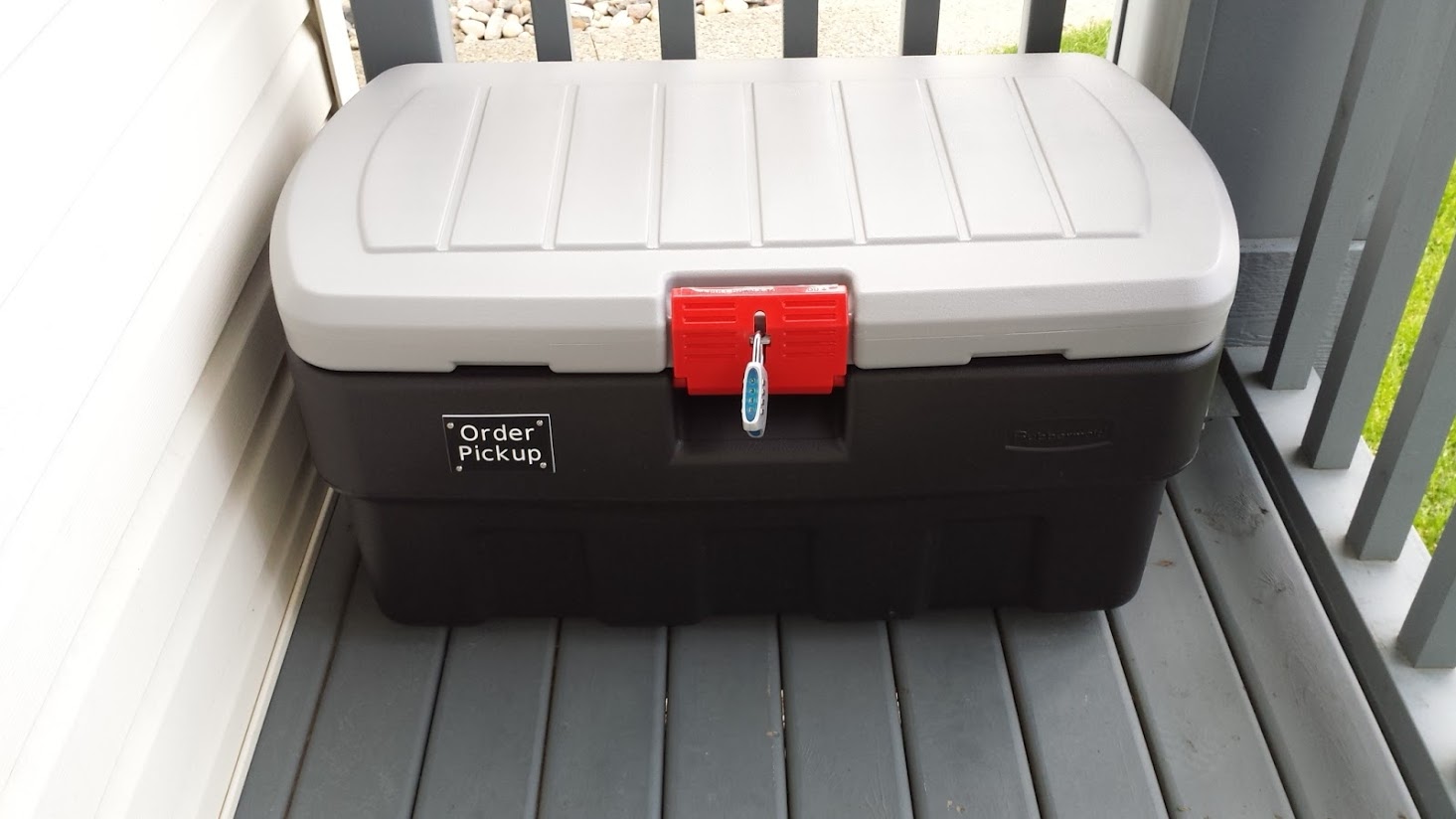 I purchased a lockable outdoor plastic storage bin and attached a sign to the front, and a cable lock to the back. Each morning, I put the bin on the front deck (a well-lit spot that was not entirely visible from the sidewalk) and secured it with the cable lock. At night I brought it indoors.
For access control, the latch was secured with a word lock. Turning the dials to form the right word would open it.
When an order was complete I would email the customer with the pickup instructions and the code for the word lock. They would come at their convenience, retrieve their order, and be on their way. If there was any issue or problem, my cell phone number was provided.
I eventually decided I had gone overboard with security and removed the word lock. It was a hassle for customers and I could always lock things down more if I ran into problems, but I was fortunate enough that none ever came up. The box even occasionally doubled as a drop-off point for other jobs and materials.
I was quite happy with the solution, and it worked well until I stopped accepting online print orders to focus instead on my own jobs, and no longer needed it. If I were to do anything differently, I would raise the bin up to waist-height for better comfort, but that’s about it.
Have You Encountered the Pickup Problem?
Have you ever run into the pickup problem as a seller or a customer, whether for 3D printing or something else? What did you do about it? If you have any insights or experiences to share, please put them in the comments because we’d love to hear them.
No comments:
Post a Comment