Friday, March 29
Hacker Abroad: Vietnam’s Electronics and Hardware Markets
Ho Chi Mihn City is the hub for sourcing the materials and tools driving the growing Vietnamese economy. Whether you’re building new, or keeping existing equipment running, the supply chains and service companies aren’t yet in place and the markets of HCMC are the go-to for parts and equipment. Let’s get a little taste of what I saw in my tour of the markets.
Forget Radio Shack: HCMC Electronics Markets



I’d love to have a market like this in my city. The electronics markets are far better stocked than any local store I’ve encountered. One of the first booths we walked past included these waist-high stacks of crates containing reels of SMD passives, boxes of axial resistors, and those are sheets of copper clad sitting on top.
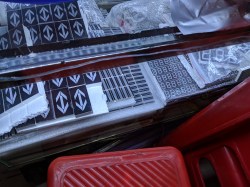
You’ll also find well-organized glass counters full of components like the trimpots shown here. There was another with all sorts of segment displays (7-segment, bar graphs, double arrows, and 8×8 dot matrix varieties are all visible). Elsewhere you can get LED strips of all kinds, and RGB LED panels. Sean Boyce was my guide on this tour and mentioned that once in a while stock will run low at some pinch point and whatever that is will become unobtainable for weeks or months. Even so, what I saw here gave me candy-store-like glee.

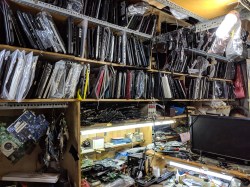
There’s some more colorful booths as well. We encountered a couple places that will sell you the name plates for whatever brand you like — Peavey, Panasonic, JBL, Toshiba, Bose, Sony, etc. The second floor of this market has a large laptop repair booth. Those shelves are full of laptop case parts, with logic boards and other add-ons below.

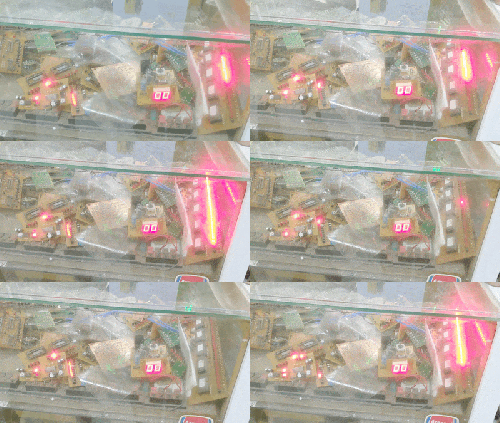
Everyone needs a hacker, and this is the electronics market’s resident hacker. He signals his talent with the blinky examples in the display case (and the LED cube hanging over his shoulder). The gentleman to the right brought in a module for some unknown equipment. That iron is kept hot and the repair began on the spot.



There is a drive-up nature to the street-side stalls. Throughout Ho Chi Minh City the sidewalks are as much for scooter parking and chairs for dining as they are for walking. Here you can see a booth that sells remote controls for air conditioners and shortly after snapping the photo I saw a man drive up and make a purchase without ever leaving his scooter.



If you look around this neighborhood it’s not hard to find piles of discarded CRTs. The copper windings have been removed and we saw more than one booth where people were winding transformers, likely with salvaged wire. Next to the discards there were carts full of salvaged speakers and logic boards which appeared to come from home audio systems.
For a complete guide on these electronics markets, Sean Boyce put together a article a couple of years back.
HCMC Hardware Markets
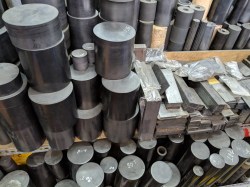
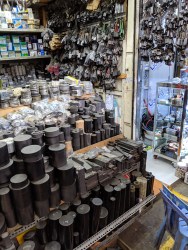

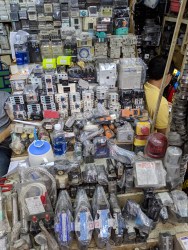
The hardware markets are in a different part of town and cater to a more industrial audience. I found the closet packed full of springs to be particularly interesting. Under the same roof you can find a booth selling graphite slugs. The small ones with wire leads are obviously brushes for motors but what about the huge cylinders? They could be for industrial-sized motors, there was a booth of shink-wrapped industrial controllers so I imagine the maintenance staff for local factories and utilities frequent this market.
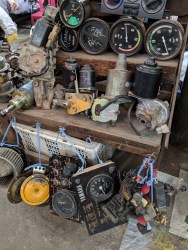

For the hardware hacker, these markets are just as interesting. Sean and I pined over the fun you could have with the salvaged dials found in one booth. You can also grab a wide range of multimeters in another street side shop.
The Food of HCMC
Ho Chi Minh City gives every appearance of having a deep addiction to delicious coffee. In fact, cold drinks in general are really big here.



Monday morning got off to a great start with a coffee from a cart on the street. The coffee is brewed in advance and delivered as a shot of thick syrup from a used soda bottle. The concoction this gentleman served up clings to the ice in the glass and doesn’t slosh around. But it certainly wakes you up! For a liquid dose of refreshment, I also recommend trying a fresh coconut which is split open as you watch and consumed with nothing more than a straw.




For breakfast Minh took us to her favorite spot for Pho. It was delicious and slightly different from what I’ve had before, with a slightly sweet broth and thicker noodles. I love fresh spring rolls and we made time to stop for those. Dessert at lunch time was a tapioca in thin cream sauce — not overly sweet and the chilled treat really takes the edge off the mid-afternoon heat (about 94 °F / 34 °C and 90% humidity). This is the second of three coffees that day. It’s common to get your cold drinks with the cup inside plastic bags or a plastic sling like this one. It keeps your hands from freezing.
This was my final day in Asia. I had an incredible time, and shared as much as I could in this Hacker Abroad series. I recorded a lot of audio for the Hackaday Podcast which needs a lot of editing time. I will do one more article to round up all those audio segments once published, so keep your eye out for one final post in this series.
iFixit teardown: Apple’s AirPods are “disappointingly disposable”
-

The OG AirPods and the new ones side by side. The latch is different, and Apple moved the sync button. [credit: iFixit ]
As expected, iFixit tore down Apple's new second-generation AirPods to see what's different about them compared to the previous iteration and just how repairable they are.
Let's get the second of those points out of the way right away: they are not serviceable at all. iFixit had to go to almost comical lengths to open the AirPods up, and despite their expertise and tools, the iFixit team was unable to do so without permanently damaging the product. They described the product as "disappointingly disposable," which is to say there is no practical way to service or repair them even at a professional shop.
That's disappointing, given that the batteries in the AirPods won't last longer than a few years with heavy use, and they're hard to recycle. Apple does offer to recycle headphones through partners as part of its Apple GiveBack program, but the GiveBack Web portal does not offer a product-specific category for AirPods to consumers like it does with most other Apple products. Consumers may simply select a general "headphones & speakers" category on the site.
Read 3 remaining paragraphs | Comments


Goodyear Aero Thinks Flying Cars are a Thing
The 2019 Geneva International Motor Show has a number of “concept” vehicles. These are vehicles that usually include some cool feature that isn’t really practical — at least today. For example, in the past, concept cars have had adjustable color interior lighting, plug-in hybrid engines, and power windows — all things that would eventually become commonly available. However, today’s advances in computer-generated graphics have meant you can show things you can’t begin to build. Case in point: Goodyear has a video touting the Aero — a solid car tire that doubles as a propeller for your garden variety flying car.
To us, the thing looks more like a science fiction movie trailer than anything remotely practical. Four relatively small wheels with no central hub can flip and provide enough lift to propel a sizeable vehicle skyward. Even more interesting, is to transition modes from ground to flight, the vehicle balances on two wheels while using only two as propellers to generate lift.
In Practice
While we love speculative thinking, this seems like a lot to swallow. Sure, sure, the future could see very high-speed motors and very lightweight vehicles. But it is hard to imagine the Aero spinning fast enough to generate enough lift to loft a person alone. There’s also the inherent safety issues. If you want to see a more plausible flying car, check out the Bell Nexus. below. See the size of those props? Goodyear also says the tires would contain fiber optic sensors to monitor the road and the tire along with an embedded AI processor because — after all — what doesn’t need that?

Ethics and Kickstarter
This is an interesting problem in engineering ethics and reminded us of a lot of various nefarious Kickstarter campaigns. With computer methods, you can mock up all sorts of impossible gadgets. Would you like a cell phone that needs charging once a month for ten minutes? So would we! We just don’t know how to make one. How about a jetpack? Why not? Granted, Goodyear isn’t seeking funding for this tire, so it isn’t quite so bad, but it doesn’t look any more practical than Hackaday announcing our new once-a-month cell phone charger available sometime in the future.
In all fairness, we aren’t exactly a bunch of flying car designers, so maybe there’s something going on here that we don’t understand. We get, too, that this is supposed to be forward-looking and not something to build today. But short of the video’s vehicles having an antigravity device, we don’t think this looks like anything we are going to see in our lifetime. Flying cars, maybe. But not with tiny propeller wheels.
Education
It isn’t just Goodyear. Every six months or so we see a newspaper article about how scientists are about to invent the transporter because quantum teleportation isn’t well understood. We see stories all the time about the next big battery technology that never seems to actually hit the market.
Arthur C. Clarke famously said, “Any sufficiently advanced technology is indistinguishable from magic.” While I think he meant that in terms of cultures colliding, we may be at a time when most people don’t understand our own technology. That may seem hard to believe if you mostly hang out at hacker spaces and surplus electronic stores. But try asking the average person how a cell phone works. Or a microwave oven.
Maybe it is time to start teaching kids a “technology” class to try to develop common sense about how tech works at a high-level. Some of these kids will become business executives, judges, and lawmakers and we’ve all seen what happens when people in those roles don’t understand the technology about which they are making decisions.
This isn’t the first time we’ve railed against flying car concepts. Like videotape, the flying car is one of those things that makes a lot of false starts into the consumer market. Videotape finally hit, but it is taking a lot longer to get the car — um — off the ground.
Hackaday Podcast Ep12: Nearly Perpetual Motion, Mars Rover Carries Kid, and Doc Brown’s Cat Feeder
Editors Elliot Williams and Mike Szczys catch up on the past week in hackerdom. It seems as if we’re in a golden age of machine building as an incredible rocker-bogie rover is built to transport a child and mechanical simplicity automates the wet cat food dispensing process. We marvel at the ability to use G-code to decorate eggs (them being curvy in more than one direction and all). The we contemplate the ability to build and start a motor which will continue to run long after your own life ends. And perhaps it’s time to add more layers to your PCB design playbook.
Take a look at the links below if you want to follow along, and as always, tell us what you think about this episode in the comments!
Direct download (52.3 MB)
Places to follow Hackaday podcasts:
Episode 012 Show Notes:
New This Week:
- Mike just got back from China and Vietnam
- Seeing glass replaced on cellphone screen modules was a really interesting
- The entire trip was shared in the Hacker Abroad series of articles
- Easter Egg decorating robots
- Elliot is building the Sphere-O-Bot (eggbot MOD) Easter Eggs creator
- Egg-bot is a well-known design from Evil Mad Scientist
Interesting Hacks of the Week:
- Magnetic Bearings Might Keep this Motor Spinning for Millennia
- Building A Turbocharger Turbojet
- Automated Cat Feeder Handles Wet Food With Aplomb
- Kid Rover Is Six Wheels Of Awesome
- From the same hacker, The Omni Wheel Robot Series is also well worth watching
- Tucoplexing: A New Charliplex for Buttons and Switches
- Full Motion Video And 3D Graphics Make This Genesis Demo Pop
Quick Hacks:
- Mike’s Picks:
- Elliot’s Picks:
Can’t-Miss Articles:
- Can You Live Without the WS2812?
- WS2813 Datasheet (PDF)
- APA109 Datasheet(PDF)
- Podcast Errata: Mike mentioned the APA102 is like SPI (which is correct). But the APA109 doesn’t. It instead uses an 800 kHz timing scheme like the WS2812.
- Stuck Designing Two-Layer PCBs? Give Four Layers a Try!