Thursday, May 30
Tiny Two-Digit Thermometer Has Long Battery Life
Like most of his work, this tiny two-digit thermometer shows that [David Johnson-Davies] has a knack for projects that make efficient use of hardware. No pin is left unused between the DS18B20 temperature sensor, the surface mount seven-segment LED displays, and the ATtiny84 driving it all. With the temperature flashing every 24 seconds and the unit spending the rest of the time in a deep sleep, a good CR2032 coin cell should power the device for nearly a year. The board itself measures only about an inch square.
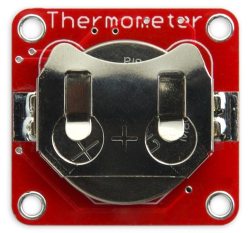 You may think that a display that flashes only once every 24 seconds might be difficult to actually read in practice, and you’d be right. [David] found that it was indeed impractical to watch the display, waiting an unknown amount of time to read some briefly-flashed surprise numbers. To solve this problem, the decimal points flash shortly before the temperature appears. This countdown alerts the viewer to an incoming display, at the cost of a virtually negligible increase to the current consumption.
[David]’s project write-up explains how everything functions. He also steps through the different parts of the source code to explain how everything works, including the low power mode. The GitHub repository holds all the source files, and the board can also be ordered direct from OSH Park via their handy shared projects feature.
Low power consumption adds complexity to projects, but the payoffs can easily be worth the time spent implementing them. We covered a detailed look into low power WiFi microcontrollers that is still relevant, and projects like this weather station demonstrate practical low power design work.
Wednesday, May 29
Turbo Subaru Gets DIY Gauges
For the average motorist, the speedometer and the fuel indicator are the primary gauges of interest. Owners of performance or modified cars tend to like having more information on the way the car is running. [JustinN1] is firmly in that camp, and built some WiFi-enabled gauges for his Subaru WRX STi.
The gauges run on the ESP32 platform, chosen for its WiFi hardware and its ease of use with the Arduino platform. This makes programming a snap, and interfacing to a smartphone easy. OLED displays were chosen for their good visibility in both day and night conditions, which is important for automotive applications.
[JustinN1] developed both a boost/vacuum gauge and an oil pressure gauge, both useful for keeping an eye on what the engine is doing. Measuring boost is as simple as using an off-the-shelf analog air pressure sensor. The oil pressure sensor is a resistive part, and must is hooked up through a resistor divider to create an analog voltage for the ESP32 to read.
Code is on Github, and there’s even a version that displays a grinning face when you get into higher boost levels. There are also a series of housings to suit various mounting choices, to help give the gauges a more finished look. We’ve seen other gauge builds too, like this gear indicator for a Suzuki motorcycle. Video after the break.
Kojima’s Death Stranding gets November 8 release date, wackadoo trailer
-

Death Stranding main character Sam plugs into a "bridge baby."
Video game auteur Hideo Kojima's first game since leaving Konami, Death Stranding, finally has a release date: November 8 for PlayStation 4 consoles. The news came at the end of the game's most revealing "gameplay" trailer yet, though as you might expect from the enigmatic Kojima, Wednesday's trailer raised more questions than it answered.
Yes, we've seen long and utterly confusing trailers for this game before, but this one comes with a semblance of a plot anchor. From what we can tell, the game revolves around a United States that has been torn asunder by some kind of plague or extinction event. The hero, Sam, played by actor Norman Reedus, is asked by the president "to help us reconnect, to make America whole." To which the character Sam replies, "You're the President of jack shit."
Yet clearly Sam is compelled to do something. This trailer shows him generating ladders and ropes to scale rocky cliffsides, getting into melee fisticuffs, hopping on a stylish, three-wheeled military vehicle, stealth-crawling through tall grass and alongside giant tanks, shooting guns, and scanning environments to discover, and stealth-sneak around, spooky creatures made of dust.
Read 3 remaining paragraphs | Comments


A Stylish Solution for Bike Navigation
[André Biagioni] is developing an open hardware bicycle navigation device called Aurora that’s so gorgeous it just might be enough to get you pedaling your way to work. This slick frame-mounted device relays information to the user through a circular array of SK6812 RGB LEDs, allowing you to find out what you need to know with just a quick glance down. No screen to squint at or buttons to press.
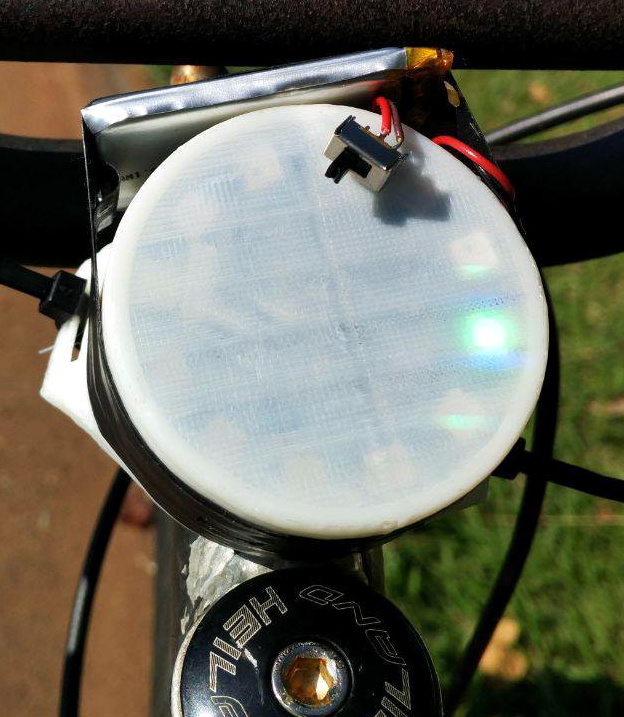 The hardware has already gone through several revisions, which is exactly what we’d expect to see for an entry into the 2019 Hackaday Prize. The proof of concept that [André] zip-tied to the front of his bike might have worked, but it wasn’t exactly the epitome of industrial design. It was enough to let him see that the idea had merit, and from there he’s been working on miniaturizing the design.
So how does it work? The nRF52832-powered Aurora connects to your phone over Bluetooth, and relays turn-by-turn navigation information to you via the circular LED array. This prevents you from having to fumble with your phone, which [André] hopes will improve safety. When you’re not heading anywhere specific, Aurora can also function as a futuristic magnetic compass.
With what appears to be at least three revisions of the Aurora hardware already completed by the time [André] put the project up on Hackaday.io, we’re very interested in seeing where it goes from here. The theme for this year’s Hackaday Prize is moving past the one-off prototype stage and designing something that’s suitable for production, and so far we’d say the Aurora project is definitely rising to the challenge.