Tuesday, September 1

Science and steely nerves spared Houston from a nightmare hurricane evacuation

Scenes of the evacuation from Hurricane Rita in Houston.

Enlarge / In parts of the city, traffic moved during the Rita evacuation. (credit: F. Carter Smith/Bloomberg via Getty Images)

HOUSTON—Jeffry Evans’ mobile phone rang shortly before 3am, local time, instantly waking him from a deep slumber.

Not good, he instinctively knew.

The Houston meteorologist had crashed late on Monday, August 24. Before hitting the mattress around midnight, he left instructions to be awakened if the forecast for Hurricane Laura took a turn for the worse. And now it had. By early Tuesday, the overnight model guidance indicated a high probability the storm may take a more westerly track across the Gulf of Mexico and strike the fourth largest US city.

Read 45 remaining paragraphs | Comments

A Cyclopic LCD Case For Your Raspberry Pi Server

If you’ve got a personal website that needs hosting or a few hundred gigabytes of files that could use a centralized storage location, the Raspberry Pi’s small size and extreme energy efficiency make it a compelling server choice compared to that curbside Pentium 4 box you’ve been trying to find a home for. All you need is something to put in.

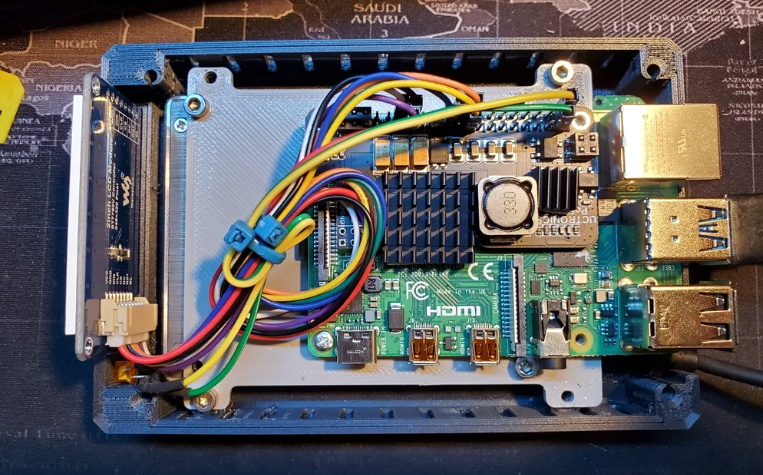
Of course there’s no shortage of Pi case designs ready to be extruded from your 3D printer, but we recently found ourselves particularly taken with this unique one designed by [Ken Segler]. It’s not only small and sleek with a dash of futuristic flair, but it includes a front-mounted two inch 240 x 320 IPS display that connects to the Pi over SPI. At the minimum that gives you a way to see all those beautiful boot messages on startup, but with a little code, it could provide you with various system statics and status messages at a glance.

While the LCD is clearly the star of the show here, the case also has a few other nice features that make it worthy of your consideration. The magnetically attached fan filter on the the top, for one. The stacked layout that puts the Pi directly above the SSD also makes for a relatively compact final product.

One thing to note though is that [Ken] is using Power-over-Ethernet, meaning there’s no spot for a dedicated power jack on the case. It’s an easy enough feature to add into your own build, but naturally not everyone’s network is suitably equipped. In that case, beyond the normal annoyances of editing STL files, it shouldn’t be too much trouble to add one in without having to literally hack your way through the printed plastic.

Empirical evidence that nice people don’t always finish last

The word JERK has been spray-painted onto a wall over where someone has thoughtlessly left an empty beer bottle.

Enlarge / Look at this jerk. (credit: Paul Sableman / Flickr)

Think your boss is a jerk? Wonder why the management of your organization consists of sociopaths? Some academic researchers suspect you're not alone, and they start their new paper with the statement, "We suffer no shortage of jerks in power." And they go on to ask the obvious question raised by this fact: "Does being a jerk help people attain power?"

To find out, the researchers set up a very long-term experiment. After administering personality surveys to undergrad and MBA students, they waited over a decade to follow up and find out which personality types had accrued power in the world of employment. The results suggest that jerks don't necessarily get ahead at work; instead, some of the consequences of being unpleasant offset the benefits that it might otherwise provide.

The technical definition of “jerk”

Believe it or not, scientists have not developed a technical definition for "jerk." But they do have one for the next best thing: disagreeable personalities, which the researchers describe as "the tendency to behave in quarrelsome, cold, callous, and selfish ways." It's a set of tendencies that tend to remain stable over time and can be identified through some basic personality surveys. And it's those later two features that enabled the researchers to think long-term.

Read 10 remaining paragraphs | Comments

Perfect Photographs For PCB Reverse Engineering

There’s an unexpected part of hacking that is very difficult to get right, namely photographing printed circuit boards. Everything seems to catch the light, making for a complex dance of manipulating light sources and camera angles. We were thus captured by [Roman Walls]’ budget rig for taking PCB photos that makes ingenious use of roadside trash to achieve a result.

It was inspired by a video featuring a much more accomplished rig, which he set out to emulate for much less outlay. Instead of an expensive lens, he’s using a Nikon camera with its kit lens. And instead of a tripod there’a a scrap drawer salvaged from the roadside and modified to become a camera holder. Lighting is diffused by baking paper, and the result is a rig that can photograph PCBs with neutral lighting and without annoying highlights.

We especially like work that takes junk and makes something useful from it, and though our purpose isn’t in reverse engineering it’s impressive to see how well the technique reveals the traces. We’ll definitely be experimenting with some of the techniques herein, and those lighting tips might also work with the Hackaday ear camera microscope.

The Hurricanes are Coming

It’s hurricane season in the northern hemisphere right now, and plenty of news and weather organizations remain dedicated to alerting people if a storm is about to impact their area. There’s no shortage of ways to receive this information, either. We all have our favorite weather app or forecasting site, and there are emergency alerts to cell phones, TV, and radio stations as well. If none of that suits you, though, you can also roll out your own weather alert readerboard.

[Damaged Dolphin] built a weather alert readerboard using a Raspberry Pi and a 64×128 LED matrix. The Raspberry Pi runs Raspbian and uses a HAT from Adafruit, and once connected to the internet pulls down weather information for a specific area using custom python code. From there it can display any emergency weather alerts instantly on the readerboard screen including alerts for hurricanes. It does rely on data from the National Weather Service though, so if that is not available in your area some modifications will need to be made to the code.

While he notes that you probably shouldn’t rely on his non-professional python code exclusively when getting weather information, it would still be a good way of retrieving information about weather events without having to refresh a browser all the time. Once the storms have passed though, be sure you’re prepared for the days following.

Thanks to [b00tfa|l] for the tip!

An Analog IC Design Book Draft

[Jean-Francois Debroux] spent 35 years designing analog ASICs. He’s started a book and while it isn’t finished — indeed he says it may never be — the 180 pages he posted on LinkedIn are a pretty good read.

The 46 sections are well organized, although some are placeholders. There are sections on design flow and the technical aspects of design. Examples range from a square root circuit to a sigma-delta modulator, although some of them are not complete yet. There are also sections on math, physics, common electronics, materials, and tools.

The text is decidedly practical. For example, there’s a succinct summary of what a MOSFET channel width and length do to parameters such as capacitance, noise, and saturated resistance.

If you prefer a PDF copy, here’s a tip. When viewing the document, click on the full-screen button. Then at the top, you’ll see a download button. The link there looks as though it isn’t a static link, so you’ll need to visit the post yourself to do the download.

It is a lot of work to put a book together and even though this isn’t complete, it is a great start and already useful. If you want some more book recommendations, check out ours. We never fail to recommend The Art of Electronics, too.

Monday, August 31

Ubisoft removes Black Lives Matter image from Tom Clancy game’s terror group

Screenshot from video game Tom Clancy's Elite Squad.

Enlarge / A shot from the introductory cut scene to Tom Clancy's Elite Squad showing a Black Lives Matter raised fist symbol used to represent the game's terrorist antagonists. (credit: Ubisoft)

Ubisoft apologized over the weekend for a cut scene in Tom Clancy's Elite Squad, a mobile game released last week, which used a raised fist symbol associated with the Black Lives Matter movement to represent an in-game terrorist organization masquerading as a populist front.

The cut scene in question shows a world descending into chaos and introduces UMBRA as a "faceless organization that wants to build a new world order" and "a new threat [emerging] to take advantage of escalating civil unrest." The group "claims to promote an egalitarian utopia to gain popular support, while behind the scenes... organiz[ing] deadly terrorist attacks to generate even more chaos and weaken governments at the cost of many innocent lives."

While the intro's entire over-the-top (and perhaps overly topical) concept was roundly mocked on social media over the weekend, the specific use of the raised fist symbol in UMBRA imagery drew condemnation from many.

Read 4 remaining paragraphs | Comments