Thursday, April 1

Activision targets Call of Duty: Warzone leaks with DMCA takedowns

Artist's conception of Activision lawyers diving into action to issue copyright notices for leaked footage.

Enlarge / Artist's conception of Activision lawyers diving into action to issue copyright notices for leaked footage.

Activision is using DMCA takedown requests to try to suppress leaked footage of a new Call of Duty: Warzone map that hit the Internet yesterday.

Copies of the leaked footage, which comes as part of a celebrity-filled promotional video for the game, is still available on YouTube, Reddit, and other sites as of this writing. Video Games Chronicle confirmed the authenticity of the leaked footage yesterday, though it didn't cite any specific sources.

This morning, though, VGC reporter Andy Robinson tweeted that his Twitter account had been locked due to a DMCA notice surrounding that coverage. "Still, as if there was any doubt, that's confirmed our story," Robinson wrote. An Activision representative was not immediately available to respond to a request for comment from Ars Technica.

Read 6 remaining paragraphs | Comments

105,000 years ago in the Kalahari Desert, people invented complex culture

105,000 years ago in the Kalahari Desert, people invented complex culture

Enlarge

Between 125,000 and 70,000 years ago, people began to do some very modern things: collecting small objects for no practical reason, decorating things with pigments, and storing water and possibly even food in containers. The oldest known sites with evidence of those behaviors are along the coastline of southern Africa. Today, most of those important sites are right on the coast, but even during the Pleistocene, when sea levels were lower, they would have been close enough for the people who lived there to make use of marine resources.

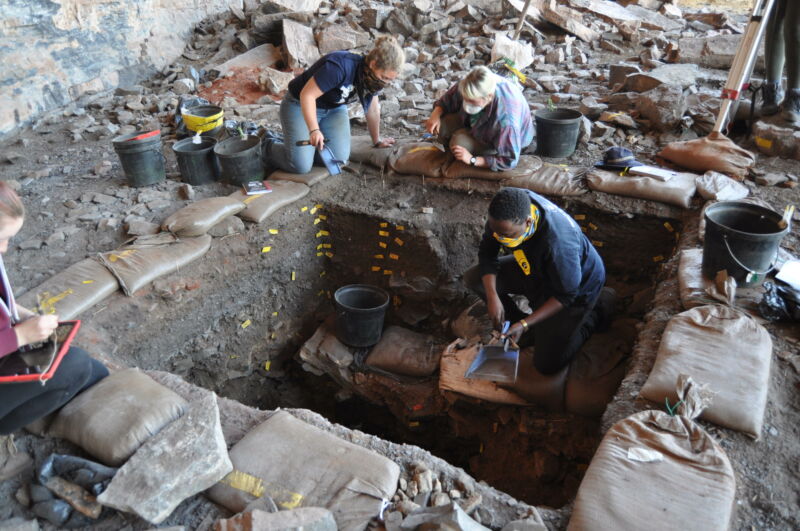
And according to one idea in paleoanthropology, something about that way of life enabled those early people—or maybe pushed them—to innovate. Their distant neighbors who lived far from the sea supposedly lagged behind the cultural times. But Griffith University archaeologist Jayne Wilkins and her colleagues recently unearthed evidence that landlocked people were just as hip and modern as their counterparts on the coast.

Score one for flyover country

At Ga-Mohana Hill North Rockshelter, there's a layer of sediment dating back to 105,000 years ago and scattered with stone tools. In it, Wilkins and her colleagues found a large chunk of red ocher, worn flat and striated on two sides, as if it had been used as pigment. The rock shelter also held a cache of translucent white calcite crystals, which hadn’t been worked or used as tools; it looked as if someone had gathered up the crystals simply for the sake of having them, or maybe as a ritual offering. Several broken, burned pieces of ostrich eggshell, buried in the same layer, may once have held stores of water.

Read 7 remaining paragraphs | Comments

Amazon colluded with publishers to fix book prices, class-action suit alleges

Amazon colluded with publishers to fix book prices, class-action suit alleges

Enlarge (credit: Johner Images / Getty)

A small independent bookstore filed a class-action lawsuit against Amazon last week, alleging that the e-commerce giant colluded with the five major book publishers to fix wholesale prices and block other sellers “from competing on price or product availability.”

The suit seeks to compensate independent booksellers for Amazon’s and publishers’ practices and put an injunction on the alleged anticompetitive practices. The named plaintiff is Bookends and Beginnings, a physical and online bookstore located in Evanston, Illinois, just north of Chicago. Amazon, which got its start selling books during the dot-com boom, has dominated the retail book market in recent years, selling an estimated 90 percent of all e-books and over 40 percent of physical books.

The current lawsuit targets Amazon’s practices in the market for physical trade books, which is publishing industry lingo for fiction and nonfiction books that are not textbooks or other reference materials.

Read 6 remaining paragraphs | Comments

Two steps forward: Virgin Galactic’s new ship and Dragon’s diverse crew

Two developments this week show how US companies are making slow but steady progress toward ushering in an era of space tourism.

On Tuesday, Virgin Galactic released images of its next-generation suborbital space plane. A few hours later, the two final crew members of an all-private mission aboard a SpaceX Crew Dragon spacecraft were publicly named. None of this is happening as quickly as we might hope, but we are slowly moving toward the day when more and more "regular" people could go into space.

First we'll look at the specifics of these announcements. Then we'll discuss their significance.

Read 15 remaining paragraphs | Comments

North Korean hackers return, target infosec researchers in new operation

North Korean hackers return, target infosec researchers in new operation

Enlarge

In January, Google and Microsoft outed what they said was North Korean government-sponsored hackers targeting security researchers. The hackers spent weeks using fake Twitter profiles—purportedly belonging to vulnerability researchers—before unleashing an Internet Explorer zero-day and a malicious Visual Studio Project, both of which installed custom malware.

Now, the same hackers are back, a Google researcher said on Wednesday, this time with a new batch of social media profiles and a fake company that claims to offer offensive security services, including penetration testing, software security assessments, and software exploits.

Once more with feeling

The homepage for the fake company is sleek and looks no different from countless real security companies all over the world.

Read 5 remaining paragraphs | Comments

Physicists give antimatter the chills

Image of coils of copper-colored metal.

Enlarge / One of the magnets used to help contain antimatter. (credit: Brookhaven National Lab)

On Wednesday, scientists reported successfully cooling atoms made of antimatter using an ultraviolet laser. The cooling process deployed here works on normal matter, so it was also expected to work just fine with the antihydrogen used for these experiments. Rather than providing yet another confirmation that matter and antimatter appear to behave the same, the experiment is significant because it increases our chances of being able to identify subtle differences between the two types of matter.

Exotic yet apparently normal

Normal matter and antimatter are notable for their ability to annihilate each other in a burst of energy when they come in contact. But otherwise, our understanding of the physics of antiparticles indicates that they should behave identically—an antiproton can pair with an antielectron to form antihydrogen, which would then be subject to forces like gravity and electromagnetism. As far as most of physics is concerned, antimatter is just matter reflected by a mirror: a few things reversed, but otherwise identical.

Testing that, however, is a challenge. All the antimatter produced naturally on Earth comes from energetic processes like radioactive decays and the impact of cosmic rays. As a result, the antimatter itself carries plenty of energy, and it moves very quickly. Similar things apply to antimatter we humans produce. It's generally made by colliding energetic particles with a stationary target, and the antimatter that comes out of these collisions is also very energetic.

Read 14 remaining paragraphs | Comments

Factory mix-up spoils 15 million doses of J&J COVID vaccine

A sign at the Johnson & Johnson campus on August 26, 2019 in Irvine, California.

Enlarge / A sign at the Johnson & Johnson campus on August 26, 2019 in Irvine, California. (credit: Getty | Mario Tama)

About 15 million doses of Johnson & Johnson’s one-shot COVID-19 vaccine were ruined, and future vaccine shipments will be delayed. This all follows a mix-up at a manufacturing facility in Baltimore, according to multiple media reports.

Johnson & Johnson had partnered with Emergent BioSolutions to manufacture the active ingredient of its vaccine. But according to two US officials who spoke with Politico, workers at the West Baltimore facility mixed up the ingredients in Johnson &Johnson’s vaccine with those for a different coronavirus vaccine. Emergent BioSolutions is also a manufacturing partner of AstraZeneca, according to the New York Times, which first reported the problem.

The mishap with Johnson & Johnson’s vaccine began before the Food and Drug Administration had authorized the facility to produce the vaccine. Now, that authorization has been delayed and shipments are stalled.

Read 4 remaining paragraphs | Comments