Thursday, April 30

Giving Surfaces Their Own Antiviral Coating To Fight Infection

The use of disinfectants is not a new thing, but a major disadvantage with most common disinfectants is that they are only effective in the short term. After applying bleach, alcohol or other disinfectant to the surface, the disinfectant’s effect quickly fades as the liquid evaporates. Ideally the disinfectant would remain on the surface, ready to disinfect when needed.

According to researchers at the Hong Kong University of Science and Technology (HKUST), the solution may lie in a heat-sensitive coating that releases disinfectant when it’s needed. This Multilevel Antimicrobial Polymer (MAP-1) can remain effective for as long as 90 days, depending on how often the surface is touched or otherwise used.

MAP-1 consists out of polymer strands of a material that prevents viruses and bacteria from attaching to its surface, while disrupting its outside surface. Effectively this has the potential to inactivate (kill) most viruses and harmful bacteria that come into contact with it.

MAP-1 is currently being deployed in Hong Kong, where public places such as schools, malls and sport facilities have had the coating applied. It costs between US $2,600 and US $50,000 to treat an area, which is not cheap, but would be cheaper than shutting down such a facility for regular surface disinfecting.

Although it still has to be determined that MAP-1 is as effective as hoped, it is another example of an antimicrobial surface, a material that is designed to be as incompatible with sustaining viruses and bacteria as possible. In the past copper and its alloys have been commonly used for this purpose, but a polymer coating is obviously more versatile. From the point of view of today’s pandemic, making surfaces incapable of hosting viruses definitely can be regarded as highly necessary.

(Pictured: a MAP-1 coating on a surface, courtesy of HKUST)
Ultrasonic Sound Gun Precisely Aims Your Music

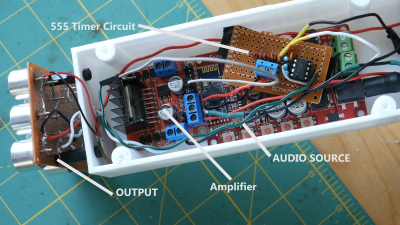
When listening to music you sometimes cannot avoid the situation where other people get annoyed because they feel it disrupts their important doings or they do not share your taste in avant-garde doom metal. Of course one could just use headphones. But a hackier way would be to build a parametric speaker that focuses soundwaves into a narrow beam like [Shane] did with this ultrasonic sound gun.

As the directivity of a soundwave depends on the size of the source and its frequency, a directed beam can practically only be achieved with ultrasound. Even though we are not able to perceive frequencies above ~20 kHz, the nonlinear properties of air make it possible to hear the audio modulated onto an ultrasonic carrier signal. For his sound gun [Shane] was inspired by another parametric speaker project. It took him some time to get the 555 timer circuit oscillating at the right frequency and he fried a cheap Bluetooth audio module while trying to increase the output volume but in the end, he managed to get everything working. As the project name suggests, he also 3D printed a gun-shaped enclosure. The video below shows that the sound from the gun behaves really similar to a beam of light and can, for example, be bounced off other objects.

If you are looking for other inspiration there is a whole list of cool ultrasonic projects from distance sensors to acoustic levitation.


Classic 8-Bit Computing the Atari Way

In the classic gaming world, even before the NES arrived on the scene, there was no name more ubiquitous than Atari. Their famous 2600 console sold almost as many units as the Nintendo 64, but was released nearly 20 years prior. In many ways, despite making mistakes that led to the video game crash of the early 80s, Atari was the first to make a path in the video game industry. If you want to explore what the era of 8-bit computing was like in the Atari age, a new resource is compiling all kinds of Atari-based projects.

This site has everything, from assembling Atari 8-bit computers based on the 6502 chip, to programming them in BASIC and assembly, to running official and homebrew games on the hardware itself. This was put together by [Jason H. Moore] who grew up around Atari systems and later, their home computers. He even puts his biomedical experience to use here by designing a game for the 2600 called Gene Medic which can be found at the site as well.

If you grew up in the 70s and 80s and are looking for a bit of Atari nostalgia this site is the place to go. It’s even worth a visit from younger folks as well since the 8-bit world is a lot easier to get immersed in and learn the fundamentals of computer science. Of course, if you want to take it the other direction, it’s possible to modify the old Atari to add a few modern conveniences.

Photo via Evan-Amos

Make It Easier For Your Software Project to Accept Contributions

[Flameeyes] has heard complaints (and at times, he admits, has complained himself) about big companies not contributing improvements to projects they seem to find useful, or rolling their own implementation rather than use and contribute to an existing code base. Having recently left Google after seven years, he has some insights into some of the reasons big corporations (at least Google, anyway) may sometimes seem to eschew making code contributions, and some of the reasons might come as a surprise.

There are things a corporation can do differently, but there are also some things that can be done on the project’s end to make accepting contributions easier. [Flameeyes] took some time to write out a few pointers on how to make it easier for others (particularly large corporations) to contribute code to a software project.

The biggest issue is the software license. Without one, there is no legal structure to use, distribute, or contribute to the code, and no corporate entity will want to touch it. Google specifically forbids creating patches for projects with either no license, or incompatible licenses. An example of an incompatible license is one that forbids commercial use, because everything a corporation like Google does — even research –is considered a commercial endeavor. In addition, on the corporate side making contributions might trigger a code review process of some kind for some licenses, but not for others. [Flameeyes] suggests the MIT license as one that is acceptable to pretty much everyone with a minimum of fuss. Another caution: if a project’s code resides in an online repository, make sure the repository is licensed as well.

A few other small suggestions (such as maintaining an AUTHORS file to track contributors in a tidy way) rounds out the advice. It sounds simple, but software licensing is so critical to the whole affair that it’s important to get it right — he suggests the REUSE tool for anyone wanting to make sure a project’s licensing is tidy.

[Flameeyes] makes a point that none of this guidance is based on secret or institutional knowledge. Google has a public document detailing exactly how they use and deal with open source, and it’s a solid guide for how to make your project more accepting of contributions from a corporate entity like Google. (Or, if you prefer, a guide on how to set up as many barriers as possible for your project.)

In case you missed it, we just want to remind you that our favorite recent open source project from Google is definitely Pigweed.

New report says SLS rocket managers concerned about fuel leaks

Technicians at NASA’s Michoud Assembly Facility in New Orleans moved the Space Launch System's liquid hydrogen tank from the factory to the dock, where it was loaded onto the Pegasus barge on Dec. 14, 2018.

Enlarge / Technicians at NASA’s Michoud Assembly Facility in New Orleans moved the Space Launch System's liquid hydrogen tank from the factory to the dock, where it was loaded onto the Pegasus barge on Dec. 14, 2018. (credit: NASA/Steven Seipel)

Every year, the US Government Accountability Office releases a report that assesses NASA's major projects. Typically, this GAO report summarizes each project and provides some basic information about schedule, cost, and concerns regarding the space agency's work.

However, the new "Assessments of Major NASA Projects" report released on Wednesday contains what seems to be an entirely new bit of information about the Space Launch System rocket NASA is developing for deep space exploration. The report asserts that engineers at NASA and the SLS rocket's core-stage contractor, Boeing, are concerned about fuel leaks.

Earlier this year, NASA moved the big rocket's core stage to a test site at Stennis Space Center in southern Mississippi. Before the COVID-19 pandemic temporarily halted work, NASA and Boeing teams were working toward a critical summer exercise. During this "green run" test, the clamped-down rocket will ignite its engines and burn for about eight minutes to simulate an ascent into orbit.

Read 5 remaining paragraphs | Comments

Wednesday, April 29

Who owns remdesivir, how much can they make, and how much does it cost?

Who owns remdesivir, how much can they make, and how much does it cost?

Enlarge (credit: Aurich Lawson / Getty)

Earlier on Wednesday, we reported on some clinical trial data that offered some good, if ambiguous, news about treating COVID-19. In the study, participants treated with a drug called remdesivir recovered on average 30 percent quicker than those receiving a placebo. But who owns the drug, how much of it can be made, and what does it cost?

To answer the first question, remdesivir is owned by Gilead Sciences, a US biotechnology company. It got its first patent for the drug in 2017, when it was originally targeting it as a possible treatment for the Ebola virus. That didn't pan out, but as our earlier article explains, biochemical similarities in how the Ebola and SARS-CoV-2 viruses function led Gilead to see if it could be repurposed for treating COVID-19. Gilead's patents mean that it has a monopoly on the drug in the United States, so barring government intervention or Gilead licensing the patent to others, it's the only company that can manufacture it until 2037, at which point a generic version could be possible.

To answer the second question, in April Gilead announced that it had ramped up production of remdesivir at its factory in La Verne, California in January, and by the beginning of April had already stockpiled enough to treat 140,000 patients, each over the course of 10 days. The company also said that it plans to produce enough remdesivir to treat 500,000 patients by October and a million patients by the end of 2020. (This explains why there was some outcry in March when it was revealed that Gilead had applied for something called "orphan drug status" for remdesivir, which is supposed to be reserved for rare diseases. Gilead withdrew that application.)

Read 2 remaining paragraphs | Comments

Lyft lays off almost 1,000 staffers as Uber weighs big layoffs

Promotional image of a Lyft driver waiting in her car.

Enlarge (credit: Lyft)

Lyft is laying of 982 people, the company said in a regulatory filing on Wednesday. That represents 17 percent of the company's official workforce (the company considers its thousands of drivers to be independent contractors).

An additional 288 employees will be furloughed, Lyft said. Most of the remaining salaried employees will take 10 percent pay cuts, while executives will face pay cuts of 20 to 30 percent.

The cuts reflect the dire state of Lyft's business during the coronavirus lockdown. Demand for on-demand passenger rides has plummeted. Lyft didn't disclose booking figures in its filing, but The Information's Amir Efrati reported last week that Uber's global bookings for ride hailing were down 80 percent. Lyft has presumably suffered similarly large losses.

Read 3 remaining paragraphs | Comments