Thursday, April 28

There she blows: Polestar shows off its wind tunnel testing

A 3D-printed scale model runs in the wind tunnel. Small tufts of wool stuck to the bodywork help visualize airflow over the body.

Enlarge / A 3D-printed scale model runs in the wind tunnel. Small tufts of wool stuck to the bodywork help visualize airflow over the body. (credit: Polestar)

Car companies can be quite secretive, and concepts can live and die without the public ever seeing more than a photograph, if that. Polestar is being much less cagey than that when it comes to the Precept, which we should see in production form in another couple of years as the brand's four-door electric flagship. The company has released a number of short films, each looking at a different aspect of the Precept's design. The most recent film covered the car's aerodynamics.

Aerodynamics matter like never before to the car industry. People won't buy electric cars that don't offer plenty of range, and a great way to kill range efficiency is to push a draggy shape through the air. The lack of a noisy internal combustion engine powertrain means that absolute noise levels in an EV are many decibels lower, which in turn makes wind or tire noise much more noticeable than in a conventionally powered vehicle.

The biggest problem that designers have are the wheels, each of which churns the air as it rotates. Fairings would be the simplest solution, but no one has been brave enough to go there since the original Honda Insight. Big open grilles matter, too, although these days, active shutters—and the optical effect of black plastic on black plastic—often minimize such penalties.

Read 3 remaining paragraphs | Comments

Moderna’s vaccine for kids under 6 now with FDA for authorization

Moderna’s vaccine for kids under 6 now with FDA for authorization

Enlarge (credit: Getty | Bloomberg)

In a move highly anticipated by parents the country over, Moderna announced Thursday that it has requested FDA authorization for its two-dose COVID-19 vaccines for children 6 months to 2 years, and 2 years to under 6 years.

If the Food and Drug Administration issues an emergency use authorization (EUA) for the vaccines, they will be the first such vaccines available to the age groups in the now nearly two-and-a-half-year-long pandemic. Parents of young, vaccine-ineligible children have been anxiously awaiting the availability of such vaccines, particularly as much of the country tries to move on from the pandemic even as the number of cases of the extremely contagious omicron subvariants continue to tick upward.

"We are proud to share that we have initiated our EUA submission for authorization for our COVID-19 vaccine for young children," Moderna CEO Stéphane Bancel said in a statement Thursday morning. "We believe mRNA-1273 [the COVID-19 vaccine] will be able to safely protect these children against SARS-CoV-2, which is so important in our continued fight against COVID-19 and will be especially welcomed by parents and caregivers."

Read 10 remaining paragraphs | Comments

Wednesday, April 27

Review: Stanley Parable: Ultra Deluxe is a mandatory game for comedy fans

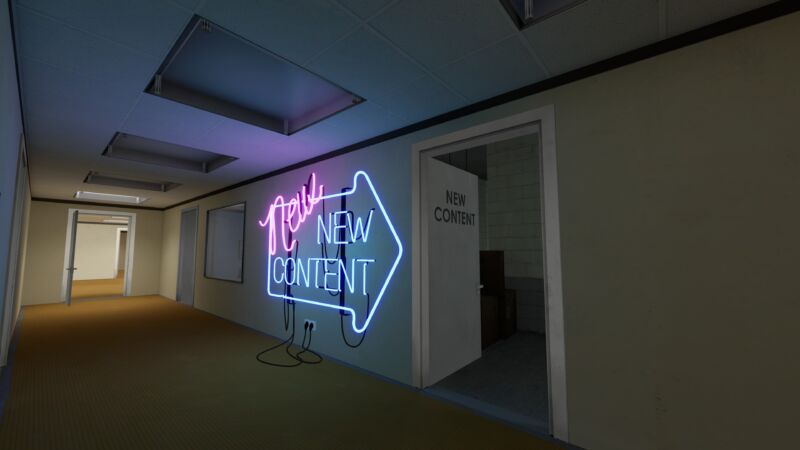
Hmm... where exactly does <em>The Stanley Parable: Ultra Deluxe</em> hide its new content?

Enlarge / Hmm... where exactly does The Stanley Parable: Ultra Deluxe hide its new content? (credit: Crows Crows Crows)

Eleven years after its debut as a Half-Life mod, The Stanley Parable remains one of the most interesting and divisive video games of the early '10s. However players may have felt about that mod or its 2013 standalone Steam launch, it was at least a very unique comedy game.

My 2013 review of the Steam version was mostly glowing. It came from a younger Sam Machkovech, a writer still surprised and delighted by concepts in video games like second-person narrative and ludonarrative dissonance.

The Stanley Parable, like many other games of its era, explored the illusion of "choice" in video games. Yet TSP stood out. While the "would you kindly" twist in that era's BioShock was meant to heighten the drama, TSP landed in a dark comedy realm. Its script and progression held some similarities to games like Spec Ops: The Line, but unlike its peers, TSP's tendency to surprise players persisted even after they were clued in to the central joke: that their choices were meaningless. Its humor was as much about novelty as it was about taking the momentum out of other games' spins on the concept.

Read 21 remaining paragraphs | Comments

New EV vs. old beater: Which is better for the environment?

New EV vs. old beater: Which is better for the environment?

Enlarge (credit: Aurich Lawson | Getty Images)

Earth Day was April 22, and its usual message—take care of our planet—has been given added urgency by the challenges highlighted in the latest IPCC report. This year, Ars is taking a look at the technologies we normally cover, from cars to chipmaking, and finding out how we can boost their sustainability and minimize their climate impact.

For many, buying an electric vehicle puts a stake in the ground—if I'm going to drive around town, I'm going to do it while reducing my carbon footprint.

“Gone are the days of burning toxic gasoline. A new age of electrons and instant torque are upon us,” you might say, standing next to your new vehicle and blue recycling bin.

Read 29 remaining paragraphs | Comments

Tuesday, April 26

Opinion: Here’s a simple way Elon Musk could make Twitter better

Last month, Twitter user Qasim Rashid tweeted the following:


These numbers are not accurate. The average price of West Texas Intermediate crude oil in June 2008 was $134, not $181.58. In March 2022, it was $108, not $99.76. Gas prices were $4.05 in June 2008 and $4.22 in March 2022. So the markup on gasoline has increased modestly since 2008, but not nearly as much as this tweet suggests.

Even so, Rashid’s tweet has racked up 18,000 retweets. As of publication time, it’s still on Twitter.

Tweets like this one are on my mind as I think about Twitter’s Monday announcement that it had accepted a deal for Elon Musk to buy Twitter for $44 billion.

Read 23 remaining paragraphs | Comments

SpaceX rapidly pivots from Dragon landing to another launch in 39 hours

A Falcon 9 rocket and Crew Dragon spacecraft are ready to launch NASA's Crew-4 mission.

Enlarge / A Falcon 9 rocket and Crew Dragon spacecraft are ready to launch NASA's Crew-4 mission. (credit: Trevor Mahlmann)

On Monday afternoon, a Crew Dragon spacecraft named Endeavour splashed down in the Atlantic Ocean off the coast of Florida. Now, less than two days later, SpaceX and NASA are preparing another Crew Dragon for launch.

Monday's landing returned a crew of four private astronauts, whose 17-day spaceflight was sponsored by the private company Axiom Space. Since that vehicle's return, the manager of NASA's Commercial Crew Program, Steve Stich, said space agency and SpaceX engineers have been "poring over the data" on Dragon's performance during its return through the atmosphere.

"It was a very clean flight overall, with really no major issues," Stich said Tuesday morning during a press call with reporters. "The team has looked through a lot of the data, and they've had a chance to review everything. They've looked at the thermal protection system. They have looked at a lot of the GNC (guidance, navigation, and control) data from the flight. Obviously, the parachutes were very clean this flight. The mains all deployed and went to full open, almost in unison, with no indication of any laggard this time, which was great."

Read 5 remaining paragraphs | Comments
Ford delays switch to Android Automotive until 2023

Ford delays switch to Android Automotive until 2023

Enlarge (credit: Aurich Lawson)

Last February, Ford announced that it was partnering with Google for its infotainment operating system. The automaker had used Blackberry QNX as the underlying OS for Sync 4, but like many other OEMs, it has found Android Automotive to be a compelling alternative. Unfortunately for Ford, that migration is not going very smoothly. Ford CEO Jim Farley told The Verge that the company is months behind schedule.

"We're making a lot of progress. I’m very impressed with the team that Google has put in place. They've been very accommodating—you can imagine that we don't want a generic solution for the instrument panel for Mustang. We want, like, line lock to do a burnout. But it is slightly delayed, so that’ll be later in the fall," Farley told the Verge.

Google's OS—distinct from Android Auto, which simply casts the phone's screen and audio to the car's infotainment system—is quickly finding favor among OEMs, which can now offer their customers the convenience of Google Maps and the highly capable Google Voice Assistant, as well as the potential for a robust third-party app market.

Read 2 remaining paragraphs | Comments