Ask any airline executive what their plans were back in January 2020, and you’d probably get the expected spiel about growing market share and improving returns for shareholders. Of course, the coronovirus pandemic quickly changed all that in the space of just a few months. Borders closed, and worldwide air travel ground to a halt.
Suddenly, the world’s airlines had thousands of planes and quite literally nowhere to go. Obviously, leaving the planes just sitting around in the open wouldn’t do them any good. So what exactly is involved in mothballing a modern airliner?
Location, Location, Location
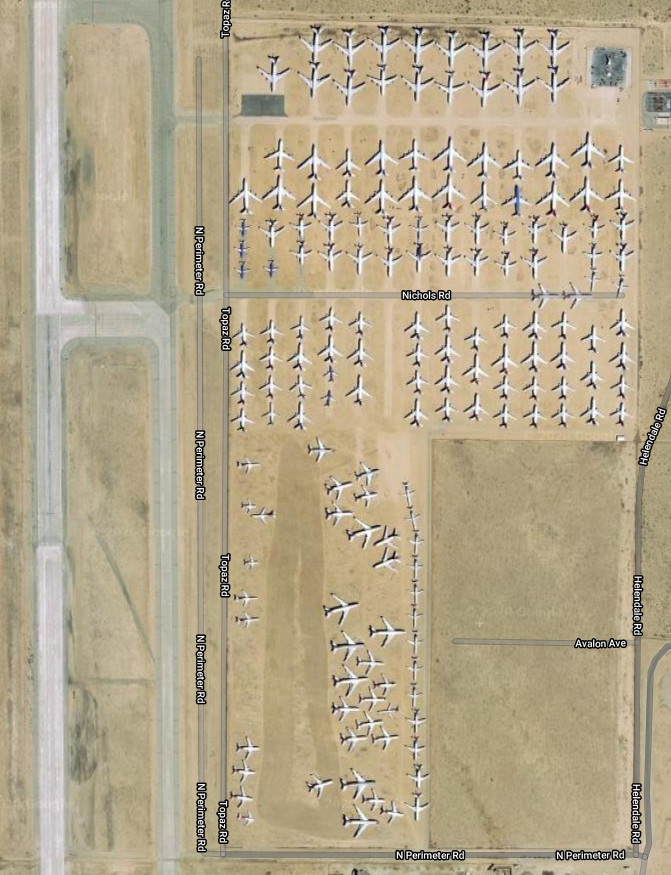
Popular locations in the US include Victorville in California and facilities in Arizona, where conditions are favorable. Similar facilities run overseas, with European airlines looking towards Spain and Australian airlines storing some aircraft in the dry climate of Alice Springs. Often, if cool and dry isn’t on the table, hot and dry is a good second-best option. As important as the location is the presence of skilled maintenance staff to carry out the work. Many airlines prefer to store their planes in locations where they can rely on their own engineering crews to look after their precious assets.
Parking Vs. Storage
When an airline decides a plane won’t be flying commerical routes for a while, a decision has to be made as to how long the plane will be decommissioned. Exact practices vary, but most draw a distinction between active parking and long-term storage.
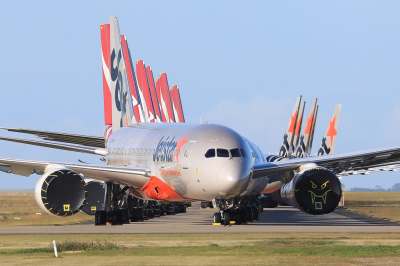
Active parking concerns planes that are being kept in a ready-to-fly or almost-ready-to-fly configuration. These planes are most typically stored at airports or facilities relatively nearby their typical operational routes. Planes in active parking are intended to be ready to rejoin the flight line within 24-48 hours when needed. In this regime, parts like landing gears will be specially lubricated and engine covers will be fitted to keep out insects and birds as well as corrosion. Other apetures, such as holes for pitot tubes and vents, will similarly be sealed. The aircraft will also be moved slightly every few weeks to avoid flat spotting the tyres. Engines, hydraulic systems, and electronics will be powered up at regular intervals every few weeks to ensure the plane remains in a functional state. This avoids negative effects such as capacitors failing from lack of use or bearings flat-spotting from long periods of sitting. Planes will also be flown periodically on short flights to ensure airworthiness.
Long-term storage is for planes that are intended to be out of action for many months before they will be called upon again. In the current climate, this is particularly relevant for large-capacity widebody aircraft, as low demand will see smaller twin-engined jets serving the majority of routes for the foreseeable future. In these cases, more work is done to prepare the aircraft for storage. Engines may be “pickled”, where their normal lubricants are replaced with special anti-corrosion agents designed to minimise the effects of time. For longer-term storage, the engines may be removed entirely and shipped back to the manufacturer.
More effort may be placed on more labor-intensive preservation methods, designed to reduce the ongoing effort required to maintain the plane in storage. Regular engine starts, landing gear checks and hydraulic tests are avoided, at the expense of the aircraft needing to go through a longer process to rejoin the flightline at the end of storage. In some cases, companies like Airbus mandate that any stored aircraft must be brought back to flight-ready status after two years, before a further storage period. With such restrictions on the table, many airlines will elect to retire or recycle an aircraft at this point rather than continue to pay the high costs of storage. Many larger aircraft, like the 747, are facing early retirement for this very reason.
It’ll Get Worse Before It Gets Better
With the pandemic raging and no end in sight, air travel looks set to remain in the doldrums for years to come. Current estimates expect the industry to be back at pre-pandemic levels by 2024 at the earliest. This has led to flow-on problems, with existing aircraft no longer the only problem. Boeing hit record production levels of the 787 Dreamliner at precisely the wrong time, and is now stuck holding an excess of undelivered aircraft. This follows on from the issues the company already faced, trying to find enough parking for grounded 737 MAX aircraft.
Thankfully, the checklist-focused and highly dilligent aerospace industry was prepared with procedures in place to handle such a situation. The real hurdle is merely overcoming the sheer scale of the problem, in both space and time. In future years, expect to see great turnover in fleets as airlines turn to newly delivered planes to replace older craft that have spent just a little too long cooking out in the desert.
Pour one out for the great flying giants of yesteryear, and maybe ask your local boneyard magnate to shout the next round at the pilot’s bar.
No comments:
Post a Comment